このガイドは現在英語版です。 日本語版は準備中です。
Car Seat Laws by Region
Child restraint requirements differ significantly between countries. Fines for non-compliance can be steep, and more importantly, the wrong setup can be dangerous.
European Union — i-Size Standard
The EU uses i-Size (ECE R129) as the modern standard, based on height rather than weight. Children must use a rear-facing seat until at least 15 months. After that, a forward-facing or rear-facing seat is required until 125 cm tall (approximately 7–8 years). Booster seats are used until 135 cm in most member states. The older ECE R44/04 standard (weight-based) is still accepted in many countries but is being phased out.
Key countries: Germany, France, Italy, Spain — all follow EU directives with minor national variations. Always check the specific country’s rules; some require rear-facing until 4 years (Sweden, Norway).
United States — LATCH and State Laws
The US uses LATCH (Lower Anchors and Tethers for Children) for installation. Laws vary by state: most require rear-facing until age 2, forward-facing with harness until age 4–5, and booster seats until age 8–12 or a specific height (often 4’9”). Some states have no booster requirement after a certain age. Never assume — check the state you’re driving in.
Australia
Children under 6 months must be in a rear-facing restraint. From 6 months to 4 years, an approved child restraint (rear or forward-facing) is required. From 4 to 7 years, a forward-facing seat or booster with harness is mandatory. Children 7–16 must use a booster if they don’t meet the adult seat belt fit (typically under 145 cm). Australian standards (AS/NZS) differ from EU and US — seats must be approved for use in Australia.
Japan
Children under 6 must use a child seat. The law does not specify rear-facing duration; however, safety experts recommend rear-facing as long as possible. Japanese rental companies often offer child seat rentals — book in advance.
Renting vs. Bringing Your Own Seat
Renting — Convenient and avoids airline baggage. Downsides: you can’t verify crash history, cleanliness, or correct fit. Inspect rental seats carefully; ensure harnesses aren’t frayed and the seat hasn’t expired (check the label — most seats expire 6–10 years after manufacture). Request the correct size for your child’s weight and height.
Bringing your own — You know the seat’s history and your child is used to it. Most airlines allow a car seat as checked baggage free; some permit it as carry-on if you buy a seat for the child. Use a travel bag to protect the seat. Ensure your seat is legal in your destination — EU i-Size seats may not be approved in Australia, and vice versa.
Age, Weight, and Height Requirements — Quick Reference
- Rear-facing: EU recommends until 15 months minimum; Sweden and Norway until 4 years. US states typically until 2 years. Best practice: keep rear-facing as long as the seat allows (usually until 18–22 kg or height limit).
- Forward-facing with harness: Until child outgrows the seat (check limits).
- Booster seat: EU until 135 cm; US until 4’9” or age 8–12 depending on state; Australia until 145 cm or age 7. The seat belt must fit correctly across the shoulder and lap.
Rear-Facing Rules — Why They Matter
Rear-facing significantly reduces the risk of head and spine injury in a crash. Nordic countries lead the world in rear-facing duration — it’s common to keep children rear-facing until age 4. If your child hasn’t outgrown their rear-facing seat, consider keeping them in it for international travel, especially in countries with strong rear-facing culture.
Entertainment & Snacks for Long Drives
Entertainment — Tablets with downloaded movies or games (no reliance on data), audiobooks, travel games, window clings, and activity books. For very young children, a mirror so they can see you can help. Avoid handing items to the driver — everything should be within the child’s reach or passed during stops.
Snacks — Easy, non-messy options: crackers, fruit pouches, dry cereal, water in spill-proof cups. Avoid choking hazards for toddlers. Plan snack stops to break up the drive and avoid eating while the car is moving for very young children.
Rest Stop Planning
Frequency — Young children need breaks every 1.5–2 hours. Plan stops at rest areas, parks, or service stations. In Europe, motorway rest stops (aires) are well-spaced; in remote areas (Australian outback, US deserts), plan more carefully.
What to look for — Toilets, space to run around, shade in hot climates. Some countries have excellent roadside facilities; others are sparse. Apps like Google Maps can help locate rest areas.
Emergency Kit for Families
Pack a dedicated kit for road trips with children:
- First aid — Bandages, antiseptic, children’s pain reliever, antihistamine, any prescribed medications
- Hydration — Extra water (more than you think you need in hot or remote areas)
- Snacks — Non-perishable backup food
- Change of clothes — For spills, accidents, or weather changes
- Comfort items — Blanket, stuffed toy, pacifier
- Documents — Copies of passports, insurance, emergency contacts
- Phone and charger — For emergencies; consider a power bank
In cold climates, add extra layers and blankets. In hot climates, sun protection and extra fluids are critical.
Installation Tips for Travel
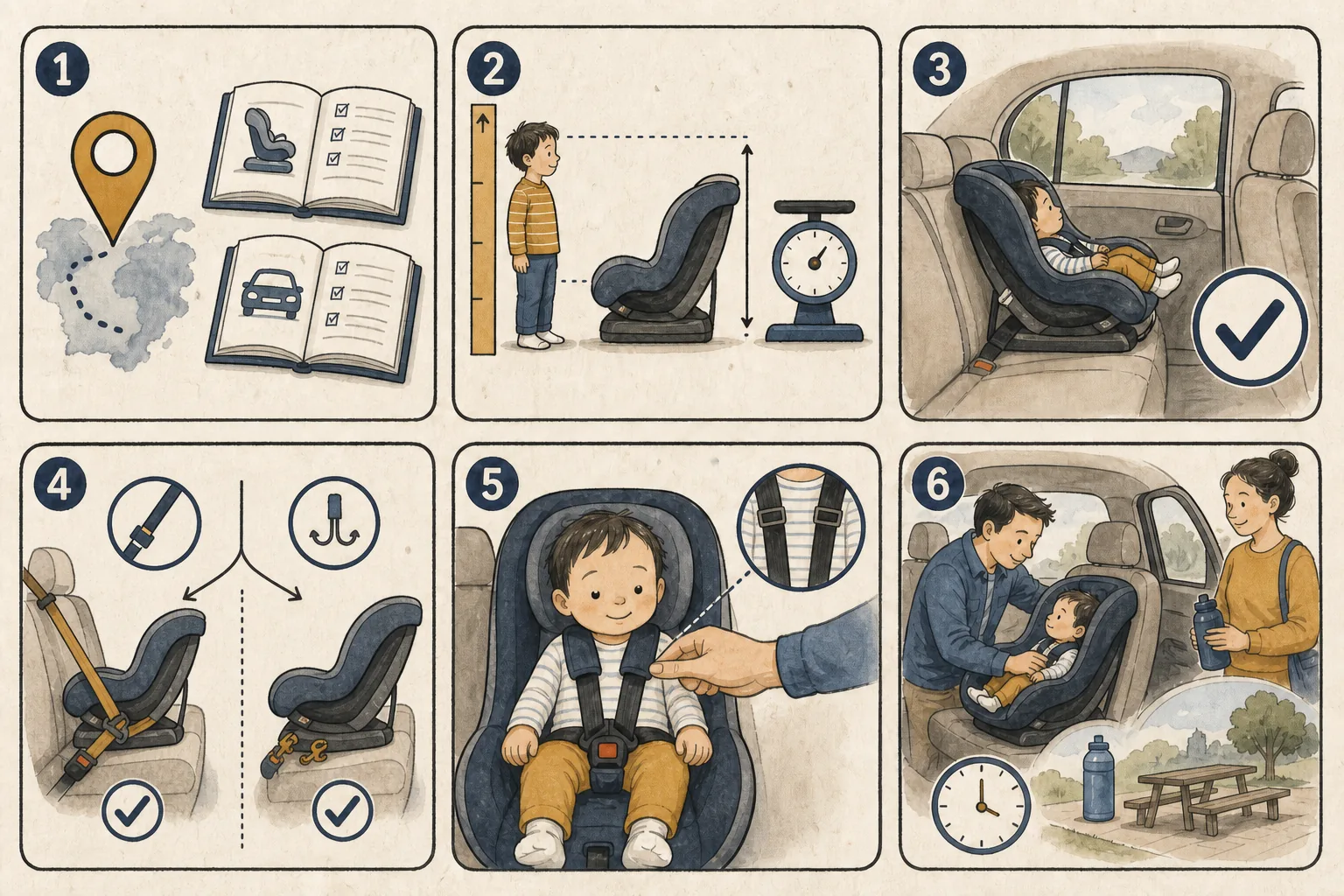
Correct fit matters — A poorly installed seat offers little protection. Ensure the harness is snug (you shouldn’t be able to pinch slack at the shoulder), the chest clip is at armpit level, and the seat doesn’t move more than 2.5 cm when tugged at the belt path. If renting a seat, ask the rental agent to help or watch an installation video for your specific model.
LATCH vs. seat belt — LATCH (ISOFIX in Europe) is often easier to install correctly. Not all seating positions have LATCH; check your rental car’s manual. Seat belt installation is universal but requires care — ensure the belt is locked and the seat is tight.
Airplane mode — Some car seats are approved for aircraft use (look for FAA or equivalent certification). Using your car seat on the plane can provide a familiar, safe restraint for your child and guarantees you have it at your destination.
Taxi and Rideshare Considerations
Taxis — In many countries, taxis are exempt from child seat requirements for short trips. This doesn’t mean it’s safe — it’s a legal loophole. For airport transfers or short urban rides, you may have no choice. For longer taxi journeys, consider bringing a lightweight travel harness or booking a car with a child seat (some services offer this).
Uber and similar — Policies vary. Uber in some cities offers car seats for an extra fee; availability is limited. In many countries, rideshare drivers are not required to provide child seats. Plan accordingly — you may need to bring your own or use alternative transport.
Country-Specific Quirks
Ireland — Children under 150 cm must use an appropriate restraint. Rear-facing recommended until 15 months. Booster cushions (backless) are legal for older children but high-back boosters are safer.
New Zealand — Children under 7 must use an approved child restraint. Similar structure to Australia. Rental companies offer seats; book in advance.
South Africa — Child restraints are mandatory for children under 3. From 3 to 14, they must use a restraint if one is available. Enforcement is inconsistent; safety standards vary. Bringing your own seat is often the safest option.
UAE — Children under 4 must use a child seat. Front seat is not allowed for children under 10. Rental cars often include child seat options.
Long-Haul Flights and Jet Lag
If you’re flying long-distance before driving, jet lag affects everyone — including the driver. Avoid driving immediately after an overnight flight if possible. Rest for at least a few hours, or stay the first night near the airport. Drowsy driving is as dangerous as drunk driving. Children may be restless or upset; plan for a shorter first day of driving. Build in flexibility for the first 24–48 hours of your trip.
Road Trip Games and Activities
I Spy, license plate bingo, 20 questions — Classic games require no equipment. Audio guides for kids (many museums and attractions offer them) can make cultural stops more engaging. Scavenger hunt lists — Print a list of things to spot (red car, cow, windmill, etc.) and check them off. Travel journals — Older children can document the trip with drawings and notes. Rest stop games — Use breaks for running, jumping, and playing — physical activity helps everyone reset for the next leg.
When Things Go Wrong
Motion sickness — Common in children. Prevention: avoid reading or screens, ensure good ventilation, offer light snacks, take breaks. Medication (e.g., Dramamine for children) can help; consult a doctor before travel. Sit in the front if age-appropriate and legal; the back seat has more motion.
Tantrums and meltdowns — Pull over when safe. Don’t try to discipline or reason while driving. A short break, a walk, or a change of activity can reset the mood. Sometimes the only solution is to stop for the day — flexibility is key when traveling with children.
Medical emergency — Know the local emergency number (112 in EU, 000 in Australia, 911 in US). Have your travel insurance details and any allergies or conditions written down in the local language. In remote areas, consider a satellite communicator for emergencies.