このガイドは現在英語版です。 日本語版は準備中です。
EV-Friendly Countries Ranking
Not all countries are equal for electric road trips. Infrastructure density, plug compatibility, and charging speed vary dramatically.
Tier 1 — Excellent: Norway, Netherlands, Germany. High charger density, multiple networks, good coverage on major routes. Norway leads globally in EV adoption; charging is ubiquitous. The Netherlands has one of the densest networks in Europe. Germany’s Autobahn corridors are well-served.
Tier 2 — Good: United Kingdom, France, Switzerland, Sweden, Denmark. Solid coverage in urban areas and along motorways. Some gaps in rural regions. UK has expanded rapidly; France’s Autoroutes have good coverage.
Tier 3 — Developing: United States, China, Spain, Italy. Major corridors and cities are covered, but coverage is patchy. US varies wildly by region — California and the Northeast are strong; the Midwest and Mountain West have gaps. China has the world’s largest charging network but plug standards differ. Spain and Italy are improving but lag behind Northern Europe.
Tier 4 — Challenging: Australia, most of Eastern Europe, rural areas globally. Sparse infrastructure, long distances between chargers. EV road trips require careful planning and may not be feasible in some regions.
Charging Networks
Tesla Supercharger — The gold standard for speed and reliability. Historically Tesla-only; increasingly open to other EVs in Europe and the US. Excellent coverage on major routes. Use the Tesla app to find and pay at compatible stations.
Ionity — European fast-charging network. Joint venture of major automakers. High-power chargers (up to 350 kW) on motorways. Membership or pay-as-you-go. Strong in Germany, France, Scandinavia, UK.
ChargePoint — US and European presence. Mix of AC and DC chargers. App-based access. Coverage varies by region.
Electrify America — US network, built as part of Volkswagen’s diesel settlement. Growing coverage, especially along interstate corridors. Reliability has improved but can still be inconsistent.
Other regional networks — Fastned (Netherlands, Germany, UK), EnBW (Germany), Pod Point (UK), EVgo (US). Many networks are interoperable through roaming agreements or apps like PlugShare.
Plug Types — Know Before You Go
CCS (Combined Charging System) — The dominant DC fast-charging standard in Europe and the US. Type 2 connector for AC, CCS adds two DC pins. Most new EVs use CCS.
CHAdeMO — Common on older Japanese EVs (Nissan Leaf, older Mitsubishi). Still supported at many stations but being phased out on new vehicles. Less common in Europe than CCS.
Type 2 (Mennekes) — European AC standard. Used for slower charging (home, destination, some public stations). All European EVs have Type 2.
GB/T — Chinese standard. Used in China only. If renting an EV in China, ensure you have the right plug; adapters exist but are not universal.
Tesla — Tesla uses its own connector in North America. In Europe, Teslas use Type 2 and CCS. Adapters exist for Tesla-to-CCS and vice versa in some regions.
Tip: Check your car’s plug type and your destination’s dominant standard. Bring an adapter if needed, though fast-charging adapters are less common and more expensive.
Apps for Finding Chargers
PlugShare — Crowdsourced database of charging stations globally. User reviews, photos, real-time availability. Essential for planning.
A Better Route Planner (ABRP) — Route planning specifically for EVs. Factors in your car’s range, charger locations, and elevation. Integrates with car data for accurate consumption estimates.
ChargeMap — Strong in Europe. Shows network coverage, plug types, and pricing.
Tesla app — For Supercharger locations and availability. Non-Tesla drivers can use it at open Superchargers.
Google Maps — Increasingly shows charging stations. Useful for quick lookups but less detailed than dedicated apps.
Rental EV Options
EV rentals are growing but still limited compared to petrol/diesel. Norway, Netherlands, and Germany have the best selection. Major firms (Hertz, Sixt, Europcar) offer EVs in many markets. Turo and similar peer-to-peer platforms sometimes have more EV options.
What to verify: Plug type, included charging cable, and whether the car comes with a charging card or app access for public networks. Some rentals include free charging; others require you to pay and claim reimbursement. Understand the fuel/charging policy before you go.
Range Anxiety Tips
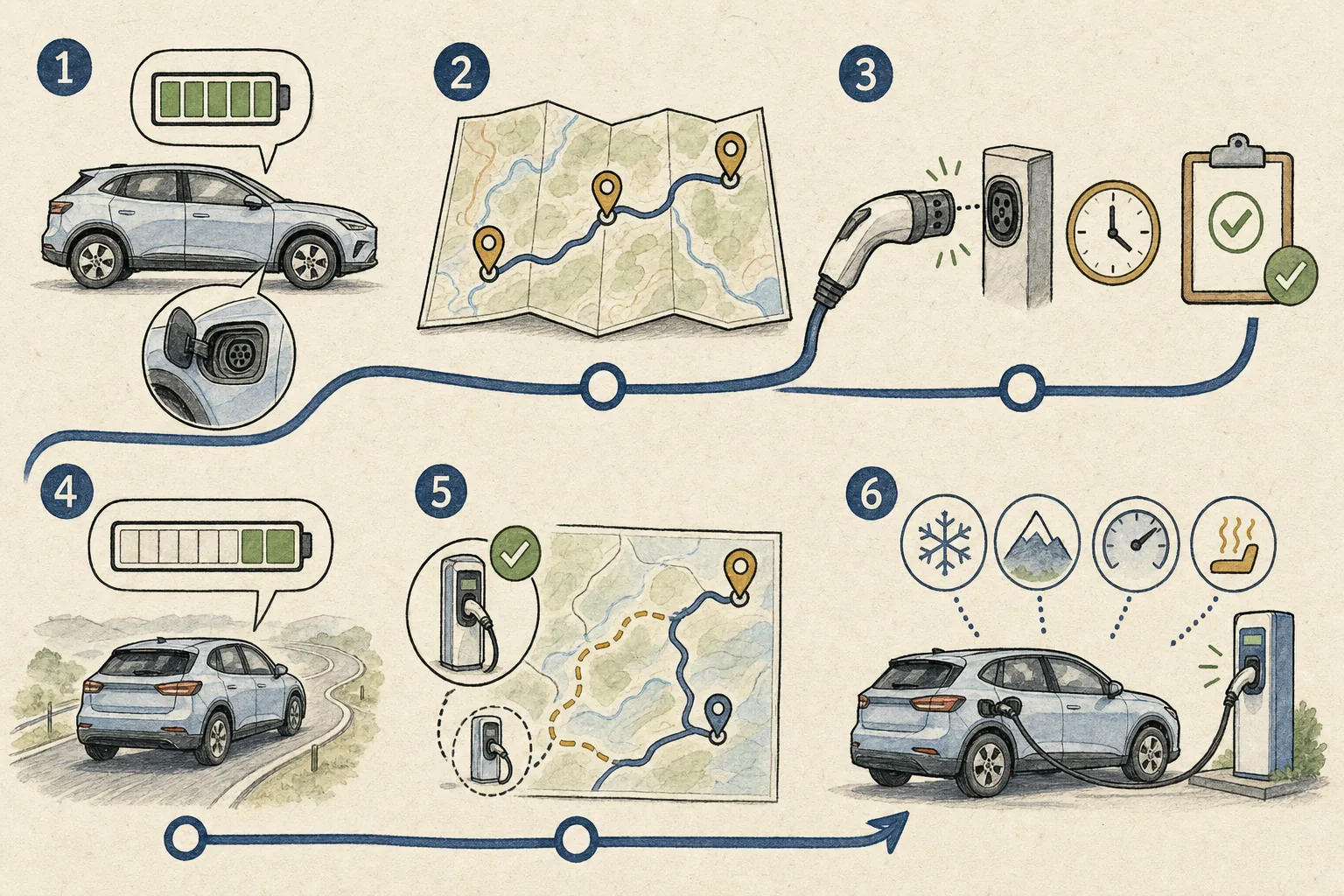
Plan charging stops in advance — Don’t rely on “I’ll find something.” Use ABRP or PlugShare to identify chargers along your route. Have backup options in case a charger is out of service.
Charge before you need to — Don’t run to 5% and hope. Top up when you’re at 20–30% in areas with sparse coverage.
Factor in conditions — Cold weather, headwinds, and mountain driving reduce range significantly. Add 20–30% buffer in winter or hilly terrain.
Know your car’s real range — Manufacturer figures are optimistic. Real-world highway range is often 15–25% less. Test on the first day of your trip.
Slow down — High speeds drain the battery faster. 100 km/h uses less energy than 130 km/h.
Countries Where EV Travel Is Challenging
Australia — Vast distances, sparse charging outside major cities. Sydney–Melbourne or Perth–anywhere are difficult. Possible with careful planning on some routes; others are not yet feasible.
Eastern Europe — Romania, Bulgaria, parts of Poland and Hungary have limited fast-charging infrastructure. Major cities may have chargers; cross-country travel is challenging.
Rural US — Large swathes of the Midwest, Mountain West, and South have few or no fast chargers. Cross-country EV road trips are possible but require detours and patience.
Developing countries — EV infrastructure is minimal in most of Africa, South America, and Southeast Asia. Stick to petrol/diesel rentals for now.
Charging Etiquette and Best Practices
Don’t hog chargers — Once your car is charged to 80% (or enough for your next leg), move it. Fast-charging slows dramatically above 80%; staying longer blocks others. Some networks charge idle fees after a grace period — Tesla and others may bill you for overstaying.
Plug in correctly — Ensure the connector is fully seated. Some chargers have screens or apps that confirm connection. If charging doesn’t start, try another stall — equipment failures are common.
Have a backup plan — Always identify a second charger option before you need it. Stations can be out of order, occupied, or incompatible. In sparse areas, the next charger might be 50+ km away.
Cost of Charging Abroad
Pricing models vary — Per kWh, per minute, or per session. Some networks require membership for best rates. Tesla Supercharger pricing differs by location and time of day in some regions. Electrify America and others use dynamic pricing.
Compare to fuel — In many European countries, fast-charging can cost nearly as much as petrol per kilometre, especially at premium networks. Slower AC charging (e.g., at hotels) is often cheaper or free. Plan your charging strategy to balance cost and convenience.
Crossing Borders with an EV
Roaming agreements — Some charging networks allow cross-border use with a single account or app. Ionity, for example, works across much of Europe. Check before you travel — you may need to download additional apps or register for new networks.
Plug compatibility — EU countries largely use the same standards (CCS, Type 2). Crossing from the UK (which also uses CCS/Type 2) to France is straightforward. US to Canada is similar. Crossing between regions with different standards (e.g., US to Europe) requires a different car or adapters that may not exist for fast charging.
Destination Charging — Hotels and Attractions
Hotel charging — Many hotels in EV-friendly countries offer charging, often free for guests. It’s slower (AC, typically 7–22 kW) but convenient for overnight stays. Book a room with a charger or confirm availability before arrival. Popular properties may have limited plugs — reserve in advance.
Attractions and shopping — Museums, malls, and tourist sites increasingly have chargers. Slower AC charging can add 30–80 km of range during a 2–3 hour visit. Useful for topping up without dedicating time to a charging stop. Check PlugShare or the venue’s website.
Home charging abroad — If staying in an Airbnb or vacation rental, ask if they have an outdoor plug. A standard domestic socket (slow, but works overnight) can add 50–100 km in 8–10 hours. Bring your granny cable (EVSE cable for domestic sockets) if your car supports it. Ensure the plug type matches the country (EU Type F, UK Type G, etc.).
Summary — EV Road Trip Essentials
Plan routes with charging in mind — Use ABRP or PlugShare. Identify chargers at 20–30% intervals, not at 5%. Know your plug type — CCS, CHAdeMO, or Tesla. Download apps before you go — Roaming data may be slow or expensive. Factor in weather — Cold and mountains reduce range. Have a backup — Know the next charger if your first choice fails. Consider destination charging — Overnight at hotels can reduce reliance on fast chargers. With preparation, EV road trips in well-served regions are increasingly practical and enjoyable.