Start with the handover sheet, not a country ranking. An electric vehicle road trip abroad is a chain of checks. The assigned car may differ from the booking model, and a listed station may be restricted, occupied, closed or fitted with the wrong connector. Build the route around evidence you can inspect.
Use the choosing a rental car guide for the contract, the road-trip packing list for cables and records, and the breakdown guide when a stop fails.
Start with the actual vehicle handover
Record battery, port and cable facts
Before leaving the branch, photograph the registration, dashboard charge level, charge-port label and every supplied cable. Record the battery capacity if the handover sheet states it, the car’s maximum AC and DC rates, and whether the car can use the connector shown on your route.
Separate rated figures from a route estimate
Use the vehicle manual or manufacturer app for connector and charging limits. Treat dashboard range as a starting estimate, then compare it with the first settled highway leg. The U.S. Department of Energy notes that temperature, speed, hills, load, acceleration and cabin heating or cooling change range. Write observed consumption beside the planned distance instead of copying a laboratory figure into every day.
 Check the charge level, cable and warning messages at handover. Photo by AbdAllah Khankan via Wikimedia Commons, CC BY 4.0.

Turn the map into a charger chain
Use an official or operator map first
Choose one station before the next rather than ranking whole countries. In the United States and Canada, the U.S. Department of Energy’s Alternative Fuels Station Locator exposes location and connector data. In Europe, the European Commission’s AFIR work is a useful policy reference, but it does not guarantee a particular site is open on your travel day. Use the charger operator’s own map for access, hours and pricing, then use an independent status or review source to spot recent failures.
Check access at the time you will arrive
Open the station page and note the address, parking rules, opening hours, connector, maximum power, payment route and whether a cable is attached. Check the last user update and call a hotel or private site when the map does not show public access. Leave the planned stop saved offline because mobile coverage can disappear before the turn.
 Set the charging route while parked and keep the passenger responsible for the screen. Photo by Shixart1985 / Nenad Stojković via Wikimedia Commons, CC BY 2.0.

Match connector, cable and charging speed
Read the vehicle and station fields together
The IEA describes seven major connector types for electric cars and notes that regional and model differences still prevent every vehicle from using every public station. The U.S. DOE consumer guide separates Level 1, Level 2 and DC fast charging, while also listing J1772, CCS, CHAdeMO and NACS in the North American context. Use those names as a compatibility check, not as a promise that an adapter exists. AC charging may require your cable; a DC station normally has its own lead.
Ask the rental desk to demonstrate one session
Have the agent show the charge-port release, cable lock, start and stop sequence, and the app or card used to pay. Confirm whether the cable stays in the car, whether an adapter is permitted, and whether a damaged cable attracts a charge. If the car is a plug-in hybrid, verify its electric-only range and whether DC fast charging is supported at all. A five-minute test near the branch is worth more than a generic network list.
Estimate energy for each leg
Use a simple route worksheet
For every leg, record starting charge, distance, elevation, speed, weather, load and the next usable station. Convert recent consumption into an energy need, then compare it with usable battery and your reserve. Mark the leg primary, backup required, or change vehicle. A mountain pass, ferry queue or border detour belongs in the worksheet even if the planner hides it.
Recalculate after the first day
Cold weather can reduce efficiency and slow charging. The U.S. Department of Energy recommends covered parking and preconditioning while the car is still plugged in, and notes that charging near the top of the battery can slow. Use the car’s own forecast after it has learned the route. Increase the reserve when the weather, road surface, traffic or altitude differs from the test leg. Do not turn a fixed percentage into a universal safety rule.
Make cross-border payment predictable
Prepare apps, cards and roaming
The IEA identifies transparent payment and station data as practical parts of charging interoperability. Before the border, install the operator app, create the account, add a card, and record the login recovery method. Ask whether the station accepts contactless debit or credit, an RFID card, a roaming account or only a local registration. A European route can still cross operators with different rules; a U.S.–Canada route can show a different currency or tax display.
Save the price basis and receipt
At the start of the session, record whether the tariff is per kWh, minute, session, parking time or a combination. Check idle fees, connection charges and tax before accepting. Save the receipt, end time and dashboard charge level. These records help with a return-charge request, a later roaming bill or a duplicated card authorisation.
Use destination charging as a second shift
Ask hotels and attractions precise questions
Confirm the connector, cable, reservation process, access hours, parking fee and whether electricity is included. A hotel’s “EV charging” label may describe one shared socket rather than a dedicated bay. Ask what happens if another guest occupies it and whether the property can keep a bay available after a late arrival. Treat attraction charging as a bonus and keep a road-side fast charger in the plan.
Be cautious with ordinary sockets
Only use a domestic outlet when the vehicle manual, property owner and approved portable EVSE all permit it. Check voltage, earthing, weather protection and the route of the cable. Do not run a lead through a public walkway, use a multi-plug extension or charge from a visibly damaged outlet. A slow overnight top-up is useful when it is authorised; it is not a substitute for a verified public station on a remote leg.
Keep a backup and recovery plan
Choose the next decision before the battery is low
Save a second station that fits the car, sits on the route and can be reached with the planned reserve. When approaching the primary site, check live status, queue information and the remaining distance to the backup. If the first site is blocked, stop changing the route while the battery is comfortable. A short AC session at a town car park can buy time to reach a confirmed DC site.
Put roadside help in the offline folder
Keep the rental recovery number, insurer, network support, station ID, registration and ferry or border contact together. Pull off safely, use the supplied warning equipment and do not troubleshoot an app beside live traffic. The car-rental insurance guide explains roadside and excess terms to confirm before pickup.
 Keep recovery numbers, a torch and the rental documents in the cabin. Photo by Oregon Department of Transportation via Wikimedia Commons, CC BY 2.0.
.jpg)
EV departure worksheet
- ☐ The assigned car, battery, charge-port type, AC/DC limits and supplied cable are written down.
- ☐ Each leg has a named primary station, a compatible backup and a reachable arrival reserve.
- ☐ Station access, opening hours, connector, cable, price basis and recent status are saved offline.
- ☐ Apps, cards, roaming accounts, recovery numbers and a second payment method work before departure.
- ☐ Weather, hills, speed, luggage, queues, ferries and border detours are in the energy estimate.
- ☐ The hotel or attraction confirms its charger, reservation, parking and billing conditions in writing.
- ☐ The rental company’s cross-border permission, return charge and damage rules are clear.
- ☐ A roadside plan exists for an occupied, broken or inaccessible station.
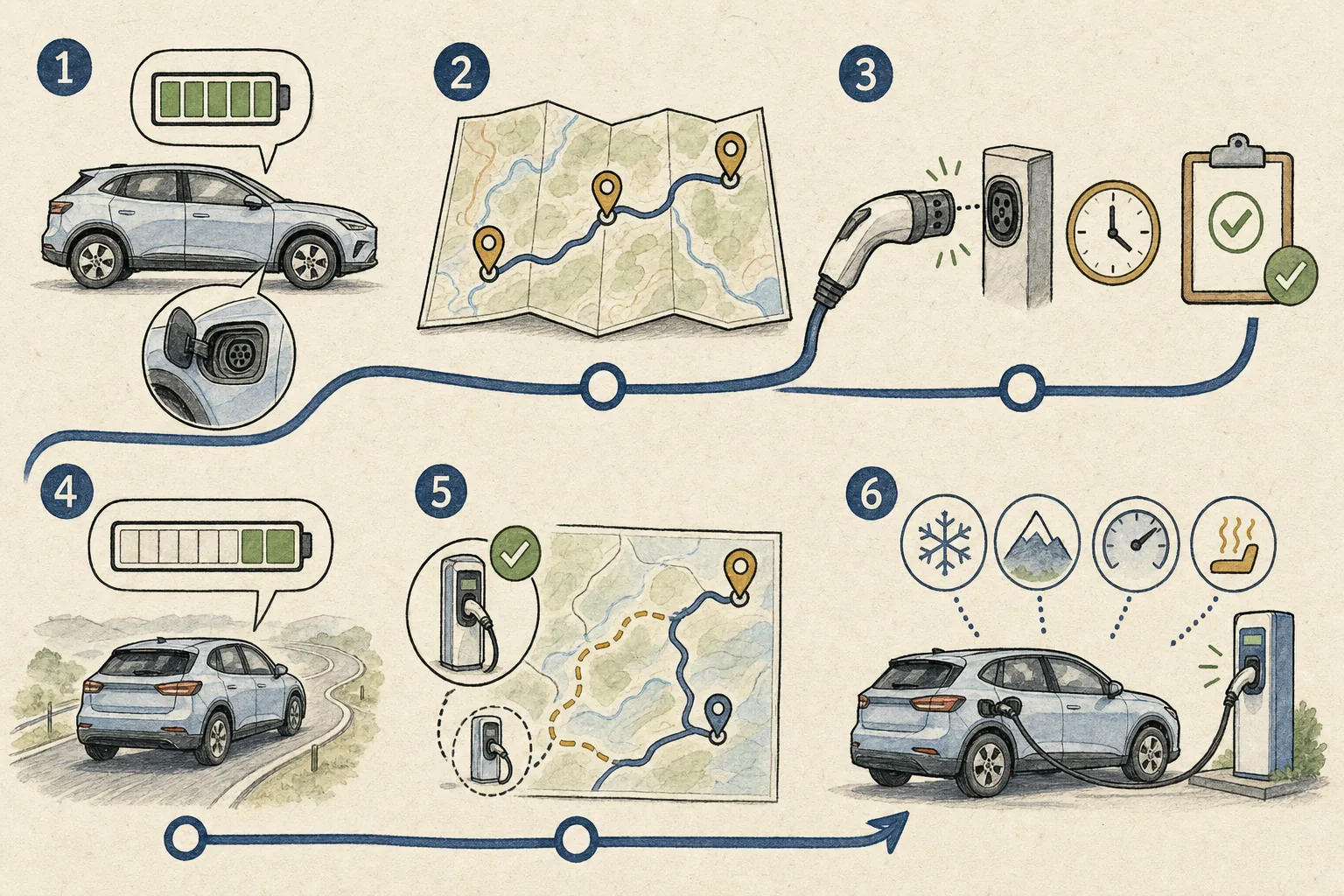
EV route check: identify the actual vehicle, chain compatible stations, test access and payment, model the next leg, retain a weather-adjusted reserve, and keep a reachable backup. A map listing is a lead for checking, not a guarantee of service. Click to enlarge.
Sources and review date
This guide was reviewed on August 17, 2026. Connector availability, operator tariffs, station access, rental fleets and cross-border conditions change. Recheck the vehicle handover, official station data, operator terms, forecast and return-charge requirement for the travel date.
- European Commission: AFIR operating recharging infrastructure Q&A
- U.S. Department of Energy: Alternative Fuels Station Locator
- U.S. Department of Energy: electric vehicles for consumers
- U.S. Department of Energy: winterizing an electric vehicle
- GOV.UK: charging infrastructure on England’s strategic road network
- IEA: Breakthrough Agenda Report 2025, road transport