ラウンドアバウトを乗り切る

ラウンドアバウトの通行ルールとヒント。

最終更新: 2026年3月16日 drivingin.world

このヒントは現在英語版です。 日本語版は準備中です。

Why Roundabouts Feel Intimidating

If you come from the US, Canada, or many parts of Asia, roundabouts may be rare or nonexistent in your daily driving. In Europe, they are the default intersection design — France alone has over 30,000. The good news: once you learn the rules, roundabouts actually flow traffic more efficiently than traffic lights. The key is understanding who has priority and when to signal.

Basic Roundabout Rules

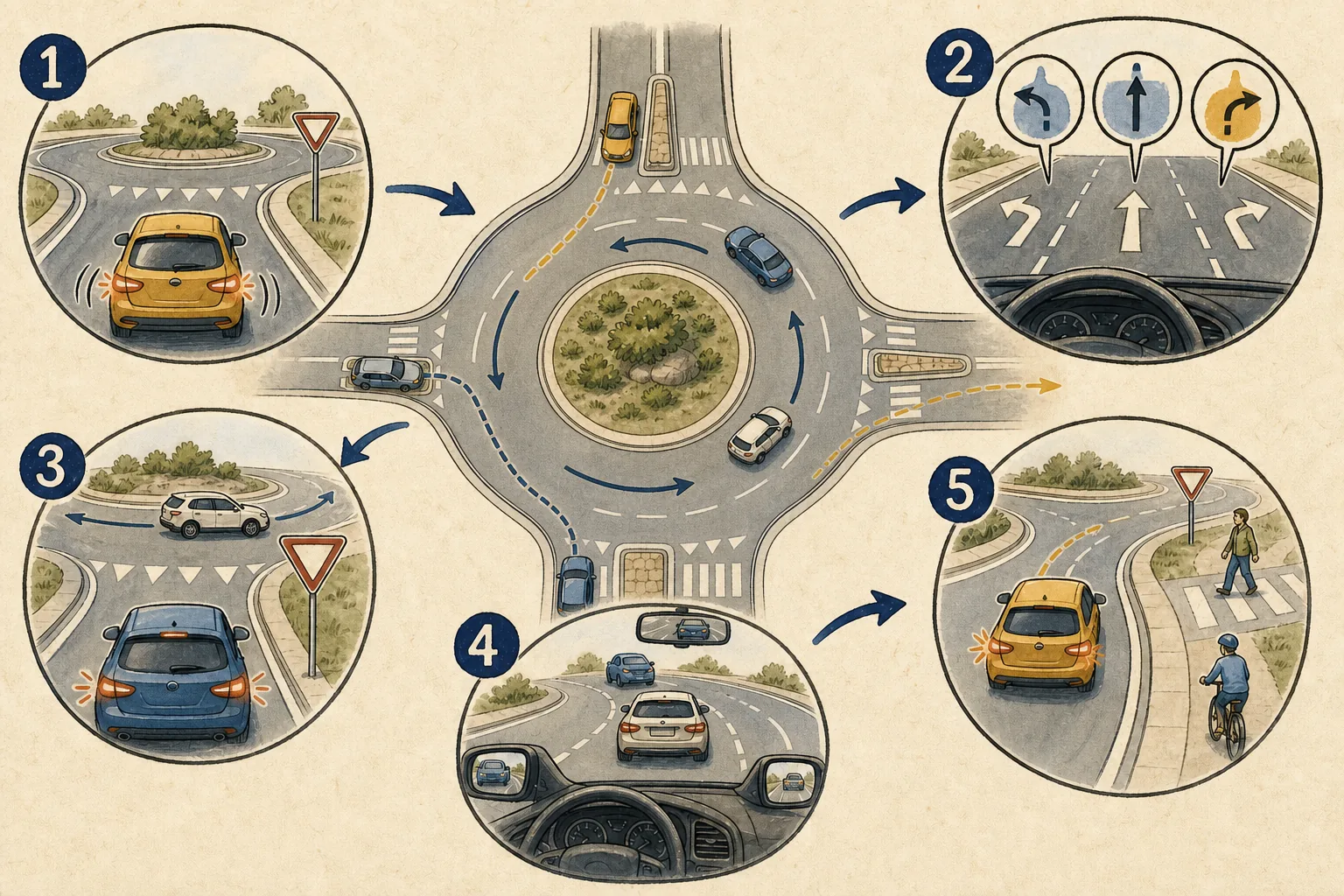
Yield to traffic already in the circle. This is the golden rule everywhere. Vehicles inside the roundabout have the right of way. Wait for a gap before entering. Never force your way in — you risk a collision and will likely be at fault.

Enter when clear. Look left (in right-hand-drive countries) or right (in left-hand-drive countries) to assess approaching traffic. If someone is close enough that you would cut them off, wait. When in doubt, wait. Hesitation is safer than a sideswipe.

Choose your lane before entering. On single-lane roundabouts, stay in the middle. On multi-lane roundabouts, the right lane is typically for exits up to and including the next exit; the left lane is for exits further around. Lane markings and signs vary by country — when unsure, take the right lane and go around again if you miss your exit.

Multi-Lane Roundabouts

Multi-lane roundabouts are where tourists get into trouble. Rule of thumb: if your exit is the first or second, use the outer (right) lane. If your exit is the third or beyond, use the inner (left) lane and signal to move right as you approach your exit.

Lane discipline matters. Do not change lanes inside the roundabout unless you are preparing to exit. Cutting across lanes mid-circle is dangerous and illegal. If you find yourself in the wrong lane, go around again — it is safer than forcing an exit.

Signaling When Exiting

Signal right when exiting. In most European countries, you must indicate right (or left in the UK) as you pass the exit before yours. This tells drivers waiting to enter that you are leaving, so they can plan their entry. Failure to signal can confuse other drivers and may result in a fine.

Some countries also require a left signal when staying in the roundabout. In the UK and Ireland, you signal left when entering and continuing around, then right when exiting. Check local rules — the principle is always to communicate your intentions.

UK Roundabouts — Clockwise and Different

UK roundabouts run clockwise because traffic drives on the left. The same yield-to-traffic-in-the-circle rule applies, but everything is mirrored. Give way to the right (traffic already in the circle approaching from your right).

UK-specific quirks: Many roundabouts have multiple lanes with painted arrows. Follow the lane markings — they often direct you to specific exits. Spiral roundabouts (where lane markings curve you toward exits) are common; trust the road markings and do not change lanes abruptly.

French Priorité à Droite Roundabouts

Most French roundabouts follow standard rules, but priorité à droite (priority to the right) still applies in some older or rural roundabouts. If you see a yellow diamond sign with a black border, you have priority. If you see a white circle with a red border, you must yield to traffic entering from the right — yes, even in a roundabout. These are rare but exist; when in doubt, yield.

Newer French roundabouts almost always give priority to traffic in the circle. The “cédez le passage” (yield) sign at entries confirms this. If everyone is yielding to you when you are inside, you have priority.

Mini-Roundabouts

Mini-roundabouts are small circles, sometimes just a painted dot in the road. Treat them like full roundabouts — yield, go around, signal when exiting. In the UK, you may drive over the centre island if your vehicle is large enough (trucks, buses) but cars should go around it. Do not treat them as a chicane; the same rules apply.

The Magic Roundabout in Swindon

Swindon’s Magic Roundabout is five mini-roundabouts arranged in a circle. It looks terrifying but is logical: treat each mini-roundabout separately. Enter, yield, navigate one mini at a time, and exit. Locals use it daily; take it slowly, follow the lane markings, and you will get through. Many visitors avoid it by taking an alternative route — that is perfectly fine.

Common Mistakes Tourists Make

Entering without yielding. The number one cause of roundabout collisions. Always wait for a safe gap.

Stopping inside the roundabout to let someone in. Do not do this. It disrupts the flow and can cause rear-end collisions. The person waiting should wait for you to pass.

Signaling left when entering (in some countries). In the UK this is correct; in France and most of Europe it is not standard. Know the local convention.

Panicking and going around multiple times. Going around again is legal and safe. Do not force an exit from the wrong lane.

Treating it like a four-way stop. There is no “your turn” — it is continuous flow. Yield and merge when safe.

Quick Reference by Country

CountryDirectionKey Rule
UK, IrelandClockwiseSignal left when staying, right when exiting
FranceAnti-clockwiseYield at entry; watch for priorité à droite in old roundabouts
GermanyAnti-clockwiseStandard rules; signal when exiting
ItalyAnti-clockwiseOften chaotic; yield and be assertive but not aggressive
SpainAnti-clockwiseStandard rules; inner lane for continuing

Roundabouts become second nature with practice. When you first arrive, consider driving through a few simple ones in a quiet area to build confidence before tackling busy urban circles.