Start with the signs, not a memorised formula
European roundabouts share a familiar shape, but their priority, lane and signalling rules are not identical. The sign and road markings at the junction take precedence over a rule learned in another country.
On approach, slow early enough to read the lane arrows. Look for a give-way line, traffic lights and signs assigning lanes to destinations. Some large roundabouts work more like a series of controlled junctions; some have lanes that spiral towards an exit; others are a single circulating lane.
Which direction does traffic circulate?
In countries where traffic keeps right, roundabout traffic usually travels anticlockwise. In countries where traffic keeps left, including the UK and Ireland, it travels clockwise. This tells you which way to look for circulating traffic, but it does not by itself decide who has priority. Follow the signs and markings at that particular entry.
 Use the approach lane arrows and the first priority sign as your local reference. Photo via Wikimedia Commons.

 Pause at a safe place before a complex junction to recheck the route and lane. Photo via Wikimedia Commons.

 Read the sign at the junction rather than importing a rule from another country. Photo via Wikimedia Commons.

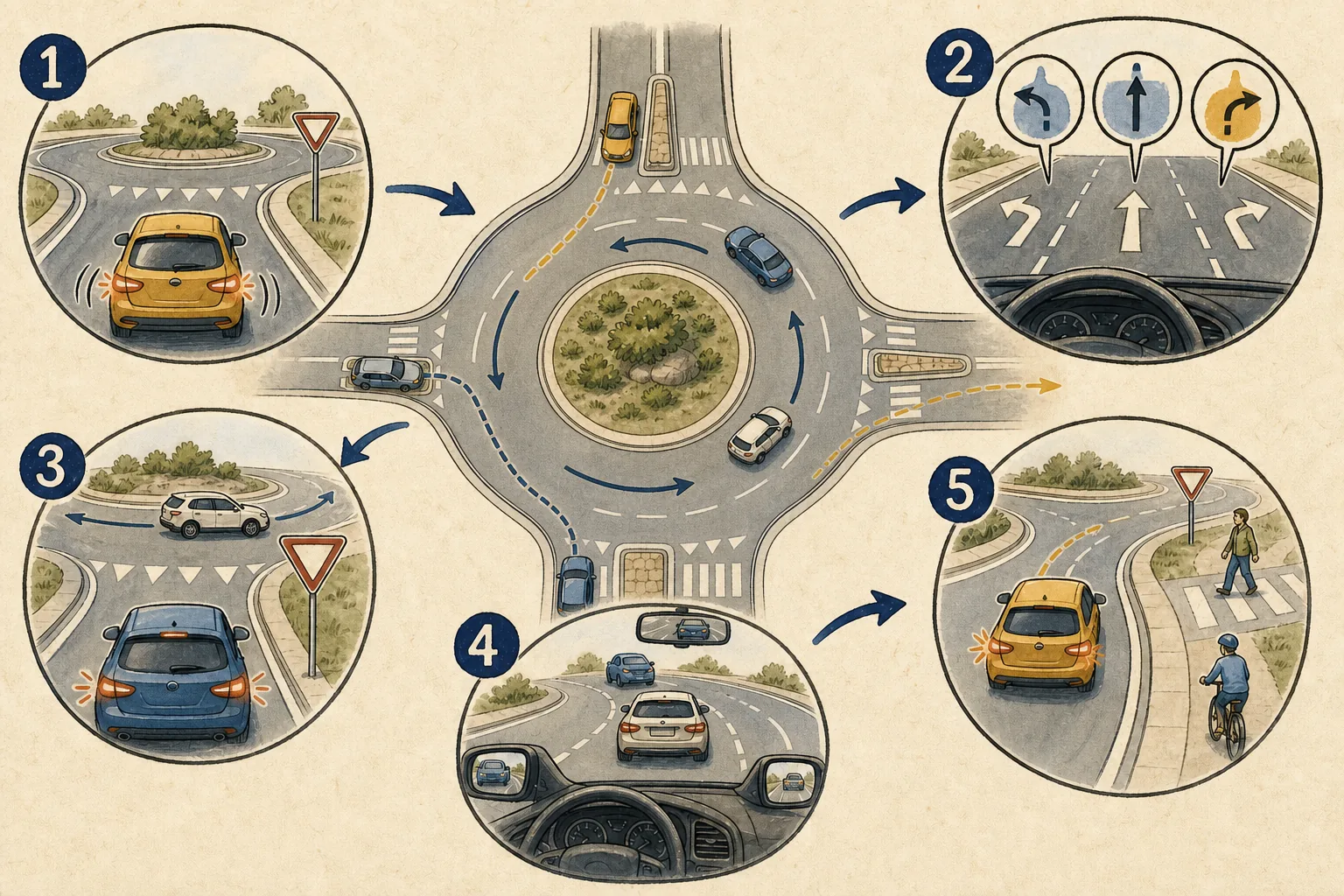
Five-step routine: 1 slow before the entry; 2 follow local arrows and signs; 3 yield as marked; 4 hold your lane and keep checking mirrors; 5 signal as required and check the exit crossing. The pictured layout is illustrative, not a universal lane rule. Click to enlarge.
Treat the junction as a sequence
Read the approach, entry and exit separately
The approach tells you where to queue and which destinations belong to each lane. The entry tells you whether to yield or obey a signal. The circulating lane tells you where to hold position. The exit may add a pedestrian or cycle crossing immediately after the give-way line. Check each stage instead of trying to solve the whole circle from one glance.
Create a reset point
If the signs are hidden by a bus, rain or a large vehicle, keep a safe gap and wait for the next clear view. If the navigation instruction and the lane arrows disagree, obey the road layout, take a permitted exit and stop somewhere safe to recheck the route. A missed exit is easier to repair than a late lane crossing.
Entering the roundabout
Check priority at the entry
Many European roundabouts have give-way signs at each entrance, which require entering drivers to wait for circulating traffic. It is unsafe to turn that common arrangement into a universal rule. Traffic lights or unusual priority signs can change it.
Approach at a speed that allows you to stop at the line. Watch for motorcycles and bicycles as well as cars. Do not enter if your move would force another road user to brake or change course.
Do not copy the car in front blindly
The driver ahead may enter a gap that is not large enough for two vehicles. Look again after that car moves. At a multi-lane entry, also check that a circulating vehicle is not moving towards the lane you intend to use.
Choose the lane before entering
Use destination signs, arrows and lane names. A simple “first two exits outside, later exits inside” rule is unreliable: lane assignments vary, and turbo or spiral roundabouts may direct a lane to a particular exit.
If you realise that you are in the wrong lane, follow its permitted direction. Do not cut across a solid line or several lanes to save the exit. Continue to a place where the route can be corrected safely. Going around again may be possible on a conventional roundabout, but not every lane layout allows it.
Driving inside and leaving
Hold a steady position and keep space from the vehicle beside you. Watch the markings because a lane may widen, split or lead out of the roundabout. Avoid changing lanes unless the layout permits it and you have checked mirrors and blind spots.
Use the indicator required by local rules. As a general observation, drivers signal towards the exit before leaving, but the entry signal and timing differ by country and by intended exit. Do not rely on another driver’s indicator as proof that the path is clear.
Check for pedestrians and cyclists at the exit. Crossings may sit just beyond the roundabout, and a driver focused on circulating traffic can overlook them.
If you miss the exit
Stay predictable. Follow your current lane and navigation directions rather than braking or steering across another lane. On a conventional layout, you may be able to circle again. On a spiral layout, the safer option may be to take the next permitted exit and let navigation recalculate.
Two layouts that need extra attention
Mini-roundabouts
A mini-roundabout may use a painted or low central marking. Treat it as the signed junction it is. In the UK, the Highway Code says vehicles must pass around the central marking unless they are physically incapable of doing so; drivers must also avoid making a U-turn at a mini-roundabout.
Multiple and spiral roundabouts
At a cluster of mini-roundabouts, handle each junction separately. At a spiral roundabout, the markings move traffic towards the selected exit. Choose the marked approach lane and remain within its boundaries instead of trying to hold an abstract “inside” or “outside” position.
UK and France: why local rules matter
United Kingdom
UK traffic circulates clockwise. The Highway Code tells drivers to use the signs and markings, get into the correct lane early and normally give priority to traffic approaching from the right unless directed otherwise. Signals depend on the intended exit: the common claim that drivers should “signal left while staying on” is incorrect.
France
French official guidance distinguishes ordinary right-side priority from a carrefour à sens giratoire, where a driver entering gives way to traffic from the left. This is why the sign at the entrance matters. A circular junction without that give-way arrangement may operate differently; do not infer priority from its shape alone.
A short routine before the first roundabout
- Read the country guide before leaving the rental location.
- Set navigation early and listen for the exit number or road name.
- Reduce speed before the lane markings become difficult to read.
- Select the marked lane and check priority signs at the entry.
- Keep your lane, signal as local rules require and check the exit crossing.
If a complicated junction appears immediately after collecting the car, it is reasonable to take a quieter route. A few extra minutes are easier to recover than an abrupt lane change.
Sources and review date
This page was reviewed on August 17, 2026 against:
- UK Highway Code: Roundabouts, rules 184–190
- French Road Safety Observatory: Code de la route
- UK Highway Code: road users at junctions and crossings
These sources explain the UK and French examples; they are not a substitute for the rules in every European country. Check the destination guide and signs at the junction.