Start with the route, not the rental desk
The UAE is easy to underestimate on a map. Dubai, Abu Dhabi, Sharjah, Al Ain, Hatta and the northern emirates are linked by broad, well-signed roads, yet a city transfer, a toll gantry and a mountain approach involve different decisions. A car is useful for a multi-emirate itinerary or for reaching the Hajar Mountains and Liwa. It is less useful for a central Dubai or Abu Dhabi stay where parking, interchanges and peak-hour traffic can consume the day.
Choose the road day first. Put the car on a confirmed highway route, leave a fuel and time margin, and only then decide whether the final stop is a paved viewpoint, a wadi access road or an off-road excursion. The UAE rental, Salik and city-parking guide covers the handover questions; the mountains and oases route adds a longer itinerary.

Licences, IDPs and the rental counter
The UAE Ministry of Economy’s rental guidance separates visitors who can rent with a home-country licence from visitors who need an International Driving Permit. Its approved list includes, among others, Australia, Canada, Japan, South Korea, New Zealand, the United Kingdom, the United States and several European countries. The list is a country-of-issue rule, not a promise that every licence format will be understood at every desk.
Dubai RTA’s foreign driving licence service describes IDP use for visitors on a visit visa. UAE residents need a UAE licence. Bring the original licence, passport, visa or entry record, and the document accepted for your nationality. If an IDP is needed, obtain it from the authority in the country that issued your licence. An IDP is a translation document, not a substitute for the original licence.
The legal minimum age for a UAE driving licence is now 17 under the current federal traffic framework, but the Ministry of Economy rental page says most rental companies require drivers to be at least 21; some high-performance vehicles require 25. Check the holding period, named-driver rule, deposit card, excess and cross-emirate permission before choosing a car.
At pickup, photograph the plate, wheels, glass, fuel or charge level, warning lights and every existing mark. Ask the branch to write down:
- whether Salik and Darb tags are active;
- how each toll, parking charge and administration fee will appear after return;
- whether Hatta, Jebel Jais, Liwa or unsealed roads are allowed;
- the roadside number and the procedure for a police report;
- the fuel, charging and cleaning standard for return.
Signs, speed and the rules that matter
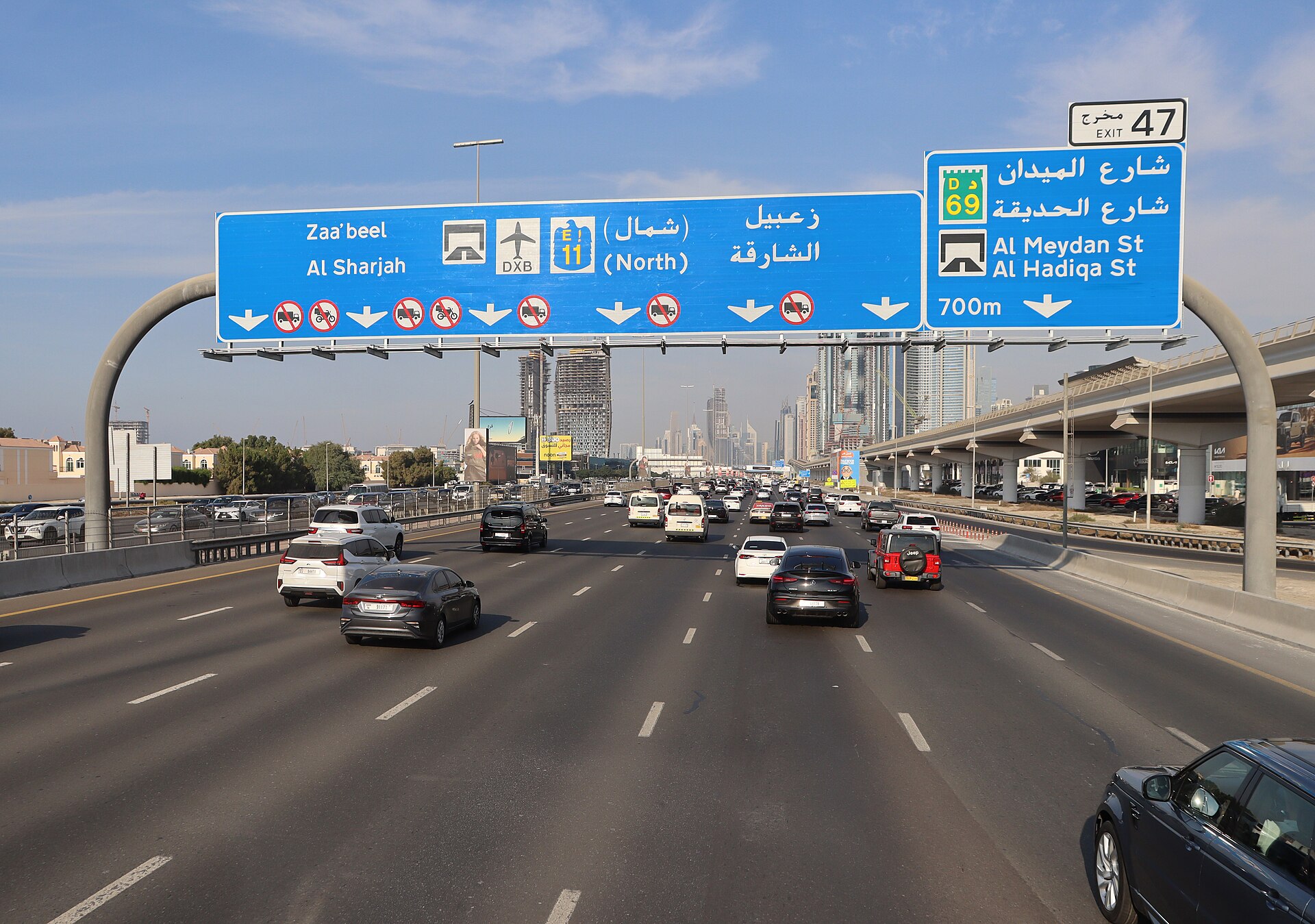
The UAE does not have one useful nationwide table of urban, rural and motorway limits. The Dubai RTA Light Motor Vehicle Handbook gives Dubai examples of 40, 60 and 80 km/h on urban roads and 100 or 120 km/h on highways. Abu Dhabi Police has signed 140 km/h sections on parts of the Abu Dhabi-Dubai route. The sign for the road you are actually on takes precedence over a guidebook.
| Setting | Working reference | What to check |
|---|---|---|
| Urban roads | 40-80 km/h in Dubai examples | The zone sign, school areas, crossings and lane arrows. |
| Other roads | Posted by road and emirate | Settlement entrances, heavy vehicles, visibility and temporary controls. |
| Highways | 100-120 km/h in Dubai examples; up to 140 km/h on signed Abu Dhabi sections | The gantry sign, vehicle class, lane position and following distance. |
Drive on the right and overtake on the left. Follow the arrows and yield lines at roundabouts and multi-level junctions; police instructions and temporary signs override the normal pattern. The current Federal Decree-Law No. 14 of 2024 applies to all road users and requires drivers to adapt speed to traffic, visibility, weather, vehicle and road conditions.
Seat belts are for every occupant. Holding a mobile phone while driving is prohibited under the traffic regulations. The federal law also prohibits driving under the influence of alcohol; it is not useful to calculate a “safe” drink limit. Keep the hard shoulder for an emergency, do not stop in a live lane for a photograph, and leave more space when dust, fog or sudden rain reduces visibility.
Dubai and Abu Dhabi are different driving days
Dubai’s road network is dense around the airport, Downtown, the marina and the major bridge approaches. A short journey can cross several lanes before the correct exit. Set the exit or parking building as the navigation destination, move early into the correct lane and avoid a last-second merge. In Abu Dhabi, the island’s grid and bridges can feel calmer, but a wrong turn still adds a long loop across the water.
Rush hour is not a fixed promise: incidents, school terms, events and weather alter it. Check the relevant police or RTA traffic feed on the morning of a long transfer. If a city stay is the main purpose of the trip, use the metro, tram, bus or taxi for the central days and collect the car when leaving.
Salik in Dubai and Darb in Abu Dhabi
Salik: variable pricing, no toll booths
Salik uses free-flow gantries and reads the vehicle tag or plate. Salik’s 2025 operational review records this schedule:
| Time | Weekdays | Sundays (except public holidays and events) |
|---|---|---|
| 06:00-10:00 | AED 6 | AED 4 |
| 10:00-16:00 | AED 4 | AED 4 |
| 16:00-20:00 | AED 6 | AED 4 |
| 20:00-01:00 | AED 4 | AED 4 |
| 01:00-06:00 | AED 0 | AED 0 |
The operator can change timing for Ramadan, public holidays or special events. Treat the table as a planning reference and check Salik’s current notice before a dated trip. A rental vehicle may already carry a tag, but the company can bill each passage and add its own administration fee. Ask for the plate number, the active tag, the billing interval and a post-rental invoice. Do not assume a second crossing is free or that an old fixed AED 4-5 tariff still applies.
Darb is Abu Dhabi’s separate system. Abu Dhabi Mobility currently lists AED 4 for each transaction between 07:00-09:00 and 15:00-19:00 on chargeable days, excluding Sundays and official holidays. Rental arrangements vary, so confirm the vehicle registration and who will settle a charge after return. Salik and Darb are not one account.
Parking without guessing the colour
Dubai parking is managed by RTA. The official parking services page links to current zone fares, operating times, payment methods and fines. Read the plate at the exact bay, note the zone code and pay through an RTA machine, SMS, app or partner channel listed by RTA. A mall’s free period does not transfer to the public street outside it.
Abu Dhabi’s Mawaqif system is more explicit about its two surface categories. Abu Dhabi Mobility lists premium spaces marked white and turquoise at AED 3 per hour, with a four-hour maximum, and standard spaces marked black and turquoise at AED 2 per hour or AED 15 for a day. The paid period is 08:00-00:00; Sundays and official holidays are free. Resident-only spaces still require the appropriate permit. Use the Darb app, a machine, a rechargeable card or another payment method shown on the official page.
For either city, take a screenshot or receipt showing the plate and expiry time. Do not block a driveway, bus stop, crossing or emergency access. If a hotel says “parking available”, confirm whether it means a private bay, valet service or a public space that still needs payment.
Mountains, wadis and desert roads
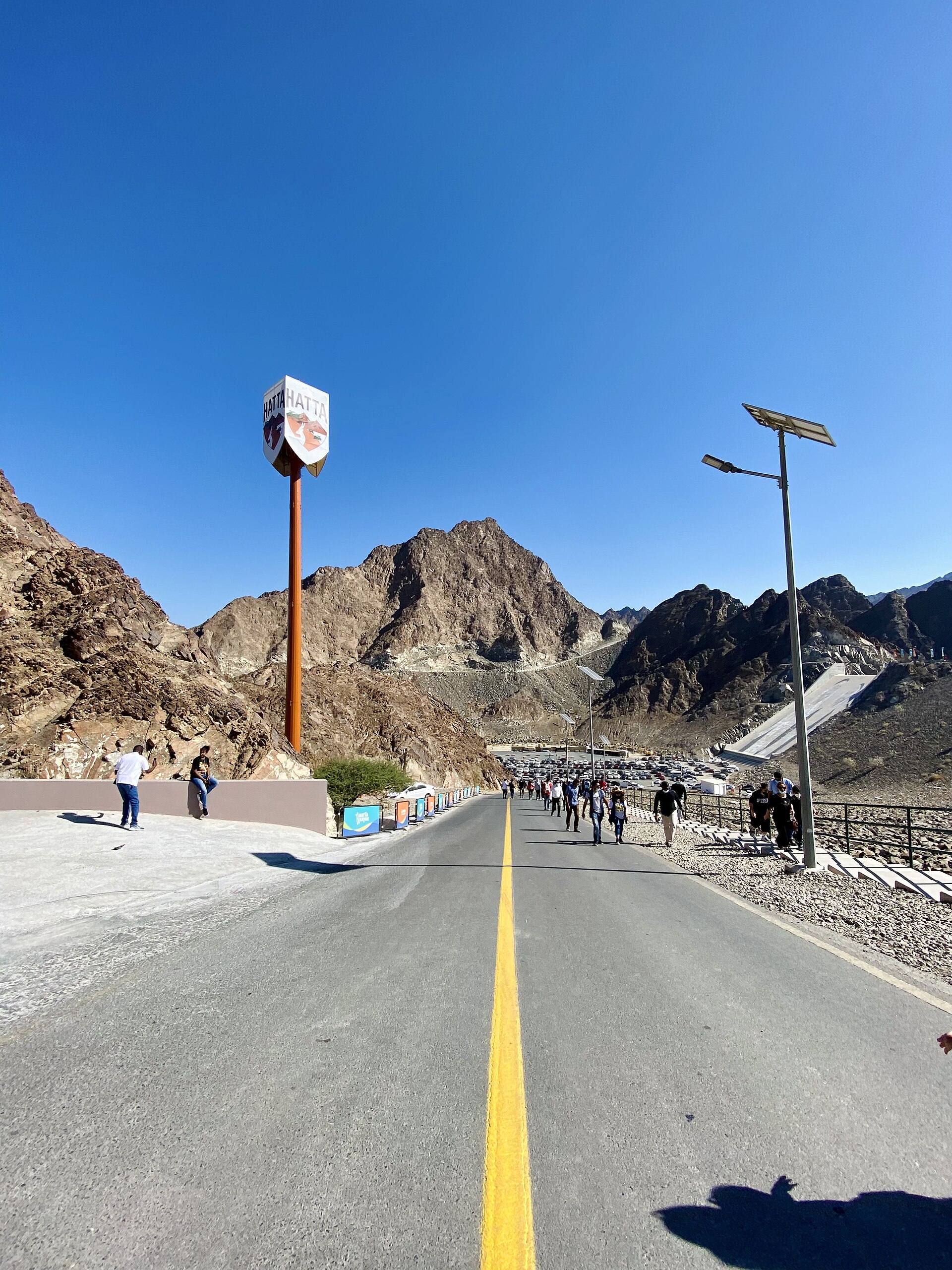
The UAE’s paved mountain roads reward an early start. Hatta’s access roads, Jebel Jais and Jebel Hafeet have bends, gradients, cyclists, pedestrians and viewpoints with limited space to turn. The RTA Hatta road updates show why road works and drainage can change an otherwise familiar approach. Check the forecast and local notices, use a lower gear on a descent, and do not stop on the carriageway.

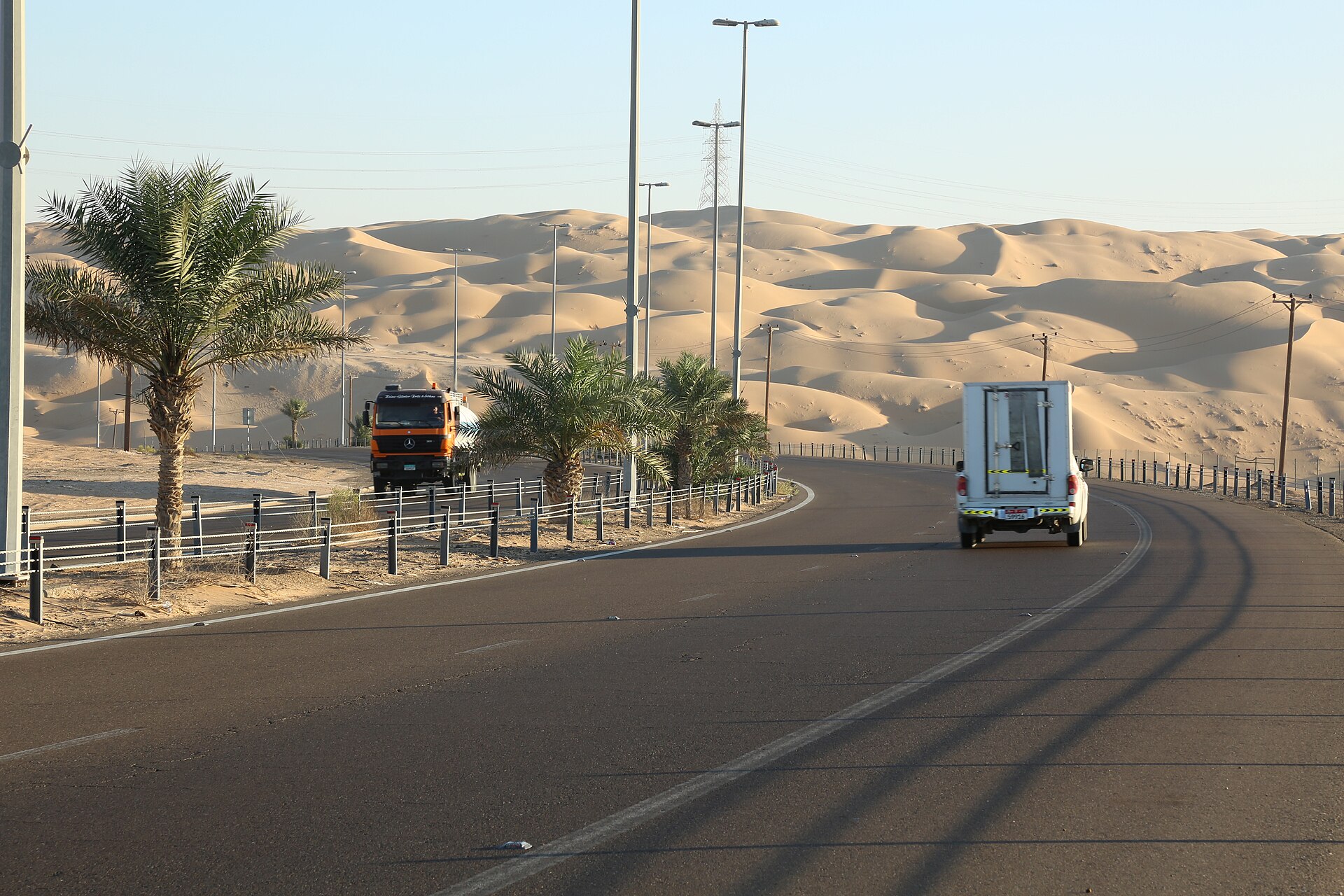
Liwa, Al Ain and the desert-edge settlements are reached by paved roads. A road beside dunes is still a road, as the image below shows. Soft sand driving is a separate activity: it needs a suitable 4WD, deflated tyres handled by someone who knows the procedure, recovery boards or a tow plan, a second vehicle or guide, extra water and explicit rental permission. A normal rental policy often excludes damage away from paved roads. Do not follow a tour convoy onto sand in a car whose contract forbids it.

Heat, fuel and charging
Heat changes the safe margin of a road day. Before leaving, inspect the tyres when cold, confirm the air-conditioning and warning lights, fill water bottles and keep the route within mobile coverage where possible. Never leave a child or animal in a parked car, even for a quick stop. A dusty or humid forecast can reduce visibility; the UAE government weather page points to National Centre of Meteorology warnings and alerts.
Fuel stations from ADNOC, ENOC and other operators are common on the main corridors. Prices and payment options change, so use the pump display and keep the receipt the rental company requests. Fill before a long Liwa or mountain stage rather than relying on the next map pin. EV charging is expanding in Dubai and Abu Dhabi, but a desert itinerary still needs live charger status, a backup stop and a reserve for heat and detours.
After a collision or breakdown
| Need | Number or action |
|---|---|
| Police | 999 |
| Ambulance | 998 |
| Fire and civil defence | 997 |
| Coastguard | 996 |
| Rental roadside assistance | The number on the rental agreement |
The UAE government’s emergency guidance says to call 999 for a road accident. If there are no injuries and the vehicle can move, get out of the live lane only when safe and follow the operator’s instructions. If anyone is injured or the scene is dangerous, leave the vehicles in place unless police or emergency staff direct otherwise. Give the exact road, direction, exit number and plate; then obtain the police report and call the rental company.
For a breakdown, switch on hazard lights, move behind a barrier if possible and do not stand between traffic and the vehicle. In a mountain or desert area, share your location before attempting a repair. The hard shoulder is not a picnic stop.
Sources and review date
This page was reviewed on 17 August 2026. Licence acceptance, toll schedules, parking tariffs, road works, weather alerts and rental terms can change. Recheck the named authority and your contract immediately before departure:
- UAE Ministry of Economy: renting a car
- Dubai RTA foreign driving licence service
- UAE federal traffic law
- Dubai RTA Light Motor Vehicle Handbook
- Salik 2025 operational review
- Abu Dhabi Darb fees
- Dubai RTA parking services
- Abu Dhabi Mawaqif
- UAE emergency guidance
- UAE weather and environmental warnings
Related guides and destinations
Frequently Asked Questions
- Can a visitor drive in the UAE with a home-country licence?
- It depends on the issuing country and the vehicle. The UAE Ministry of Economy publishes a list of nationalities whose visitors can rent with their home licence; other nationalities need a valid International Driving Permit as well as the original licence. Dubai RTA also limits foreign IDL use to visitors, not UAE residents. Confirm the current rule with the relevant emirate and rental branch before paying the deposit.
- Is an International Driving Permit required for every visitor?
- No. There is no blanket requirement for every nationality. Carry the original licence, passport and the document accepted by the rental branch. If your country is outside the UAE's approved home-licence list, obtain an IDP before travel; an IDP never replaces the original licence.
- How much does Salik cost in Dubai?
- Salik introduced variable pricing. The 2025 operating schedule lists AED 6 during weekday peak periods, AED 4 during weekday off-peak periods, and no charge from 1:00 to 6:00. Sundays have a separate schedule, and Ramadan, public holidays or events can change the timing. Rental companies may add an administration charge, so ask how the tag and post-rental bill work.
- What is the difference between Salik and Darb?
- Salik is Dubai's free-flow toll network. Darb is Abu Dhabi's toll system, with AED 4 charged per transaction during 07:00-09:00 and 15:00-19:00 on chargeable days according to Abu Dhabi Mobility. The two accounts and billing systems are separate; a rental contract should state how each one is handled.
- How do I pay for parking in Dubai and Abu Dhabi?
- Dubai parking prices and operating hours depend on the signed zone; use an RTA machine, SMS, app or another method listed by RTA. Abu Dhabi's Mawaqif uses marked premium and standard spaces, with payment through the Darb app, machines, card or other listed channels. Read the sign beside the exact bay rather than relying on a colour remembered from another street.
- Can I take a normal rental car into the desert?
- A paved road to Liwa, Al Ain or a desert viewpoint is a normal road trip. Driving on soft sand is a separate activity that needs an appropriate 4WD, recovery equipment, a second vehicle or experienced guide, water and a rental contract that permits it. Many policies exclude off-road damage; never treat a public-road rental as a dune vehicle.
- Are Hatta and the UAE mountain roads difficult?
- Main roads to Hatta, Jebel Jais and Jebel Hafeet are paved, but gradients, bends, cyclists, pedestrians and sudden weather still require a slower approach. Use daylight for an unfamiliar route, check the forecast and road notices, and keep the vehicle on roads allowed by the rental agreement.
- What are the UAE emergency numbers after a crash?
- Call 999 for police, 998 for an ambulance and 997 for fire or civil defence. For a minor collision with no injury, move to a safe shoulder only when it is safe and follow the police instructions. Keep the rental company's roadside number and the car's plate number ready.
- Can I drink alcohol and then drive in the UAE?
- Do not drive after drinking. Federal Decree-Law No. 14 of 2024 penalises driving or attempting to drive under the influence of alcohol, with imprisonment and a fine of AED 20,000-100,000. Alcohol rules for licensed venues do not create a safe driving allowance.
Information Sources & Disclaimer
This guide compiles information from the official transport authorities, road operators, government travel information, and automobile associations linked for United Arab Emirates.
While we strive to keep this information as accurate and up-to-date as possible (last reviewed: August 2026), traffic laws and toll rates can change without notice. We recommend verifying critical information with the local authorities or your car rental agency upon arrival.
Learn more about our Editorial Process →Compare Your Origin and Destination
Use the comparison tool to check driving side, units, documents, and other destination data for your route.