Why Tolls Vary So Much
Road charging is a route-level question, not a reliable country stereotype. One journey may combine a motorway toll, a special tunnel charge, a city congestion zone and a rental-company processing fee. Check the road operator for the exact section and vehicle class before relying on a map estimate.
Toll Systems by Type
Cash / Card Booths
Where it appears: Many ticketed motorways in France, Italy, Spain, Portugal and some US states.
Take a ticket only when the lane tells you to do so, keep it dry, and pay at the matching exit. Card acceptance, lane colours and staffed hours vary; keep a second payment method and never reverse if you enter the wrong lane.
Electronic Stickers (Vignettes)
Where it appears: Time-based systems such as Austria and Switzerland, with different products and validity rules in each country.
Buy through the road authority or an authorised seller, enter the plate exactly, and save the confirmation. A vignette may cover only specified roads; Austria also has separate section tolls. Penalties and replacement charges change, so check the official enforcement page rather than using an old fine amount.
Where to buy: Prefer the official toll shop or a listed point of sale; border fuel stations are useful only when the product and plate details are clear.
Electronic Transponders
Examples: Japan ETC, Portugal Via Verde, US state transponders and Australia’s Linkt network.
Ask whether the device is active, which roads it covers, and whether the rental company bills the toll plus a separate administration fee. Photograph the device and the contract page before leaving the branch.
Distance-Based Electronic
Examples: UK Dart Charge, Ireland eFlow and other plate-based schemes.
There may be no booth. A camera records the plate and the operator sets the payment window, account rules and late-payment process. Confirm the deadline on the operator’s site and keep the payment receipt with the rental agreement.
 Record the plate, device and contract toll option before leaving the rental branch. Photo via Wikimedia Commons.

 The sign at the entry identifies the lane and often the road class; do not follow a vehicle into a lane you cannot use. Photo via Wikimedia Commons.

 Keep the toll account, receipt and alternative route details accessible before the car starts moving. Photo via Wikimedia Commons.

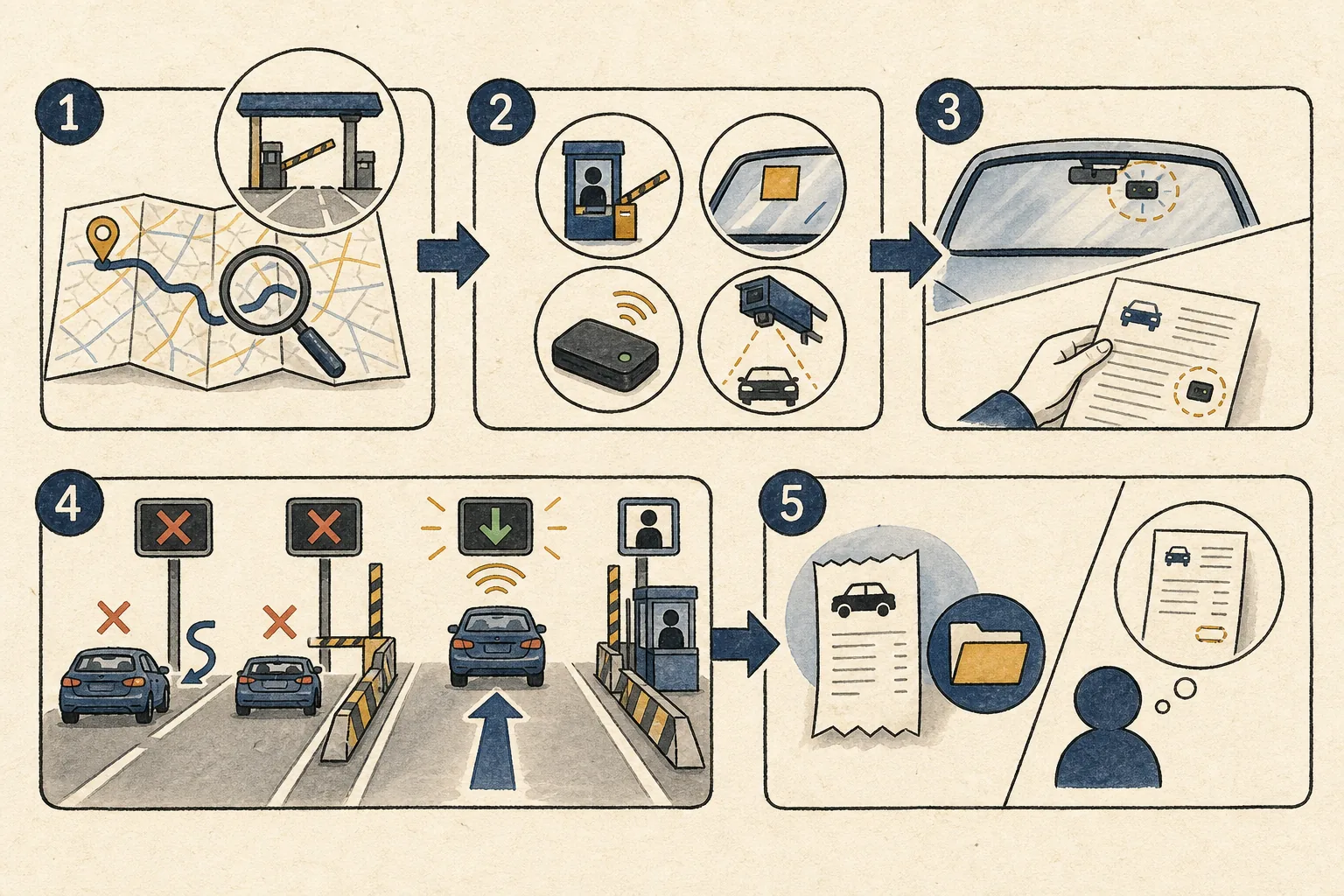
Toll checklist: 1 find tolled sections before departure; 2 identify booths, vignettes, transponders or plate billing; 3 check the rental car and contract; 4 use the indicated lane and never reverse at a toll point; 5 retain the record and watch for later rental-company charges. Click to enlarge.
A route worksheet before departure
| Route check | What to record | Where to verify |
|---|---|---|
| Austria | Vignette, section-toll stretches, plate and start date | ASFINAG toll shop |
| Switzerland | E-vignette or sticker, plate link and validity window | Swiss FOCBS vignette guidance |
| UK | Dart Charge or road-specific operator, payment deadline | Dart Charge |
| EU route | Distance toll versus time vignette, vehicle class and payment channel | European Commission road charging |
| Japan / US / Australia | ETC or state/network account, rental-device policy | The road operator and rental contract for that route |
Tips for Rental Car Drivers
- Ask about tolls at pickup: Does the car have a transponder? How are tolls billed?
- Separate tolls from fees: the road charge, rental-company administration fee and late-payment penalty are different lines. Ask for the tariff and trigger for each.
- Plan with toll-free routes: use an avoid-tolls option as a comparison, then check whether it adds border crossings, ferries or unsafe night driving.
- Keep receipts: save the plate, transaction ID, timestamp and route section until the card statement is reconciled.
- Check validity before moving: a time-based product is tied to a start date, while a digital product may be tied to the plate; verify both on the authority’s checker.
Common Mistakes
- Buying from a look-alike website: use the operator’s domain or a listed seller and keep the confirmation page.
- Entering the wrong plate: a digital vignette or camera bill may follow the plate, not the person who paid.
- Treating a rental transponder as universal: ask which network and countries are covered.
- Missing a plate-payment deadline: do not wait for the rental company’s invoice; the authority’s deadline applies first.
- Reversing at a toll point: stop, follow the lane staff or intercom, and let the operator correct the transaction.
Sources and review date
This page was reviewed on August 17, 2026 against the route-level guidance from the European Commission, ASFINAG, Swiss FOCBS and Dart Charge. Prices, products and deadlines can change; verify the operator before paying.