Why Parking Abroad Is Tricky
Parking rules can change between countries and neighboring cities. A blue zone in Italy may use different payment and time-limit rules from one in France. Read the main sign and every supplementary plate before leaving the car.
Read the whole parking rule
Paint colour is a clue, not a worldwide code. The sign, arrow, bay marking, curb, payment machine and supplementary plate form one rule. A blue bay may require a ticket, a disc or a resident permit depending on the city; a yellow line may reserve loading, buses or residents. Treat a colour-only answer as incomplete.
Before leaving the car, record five facts: the permitted vehicle or user, days and hours, maximum stay, payment channel and the direction covered by the arrow. If two signs conflict, use the more specific nearby sign and ask the parking operator before walking away.

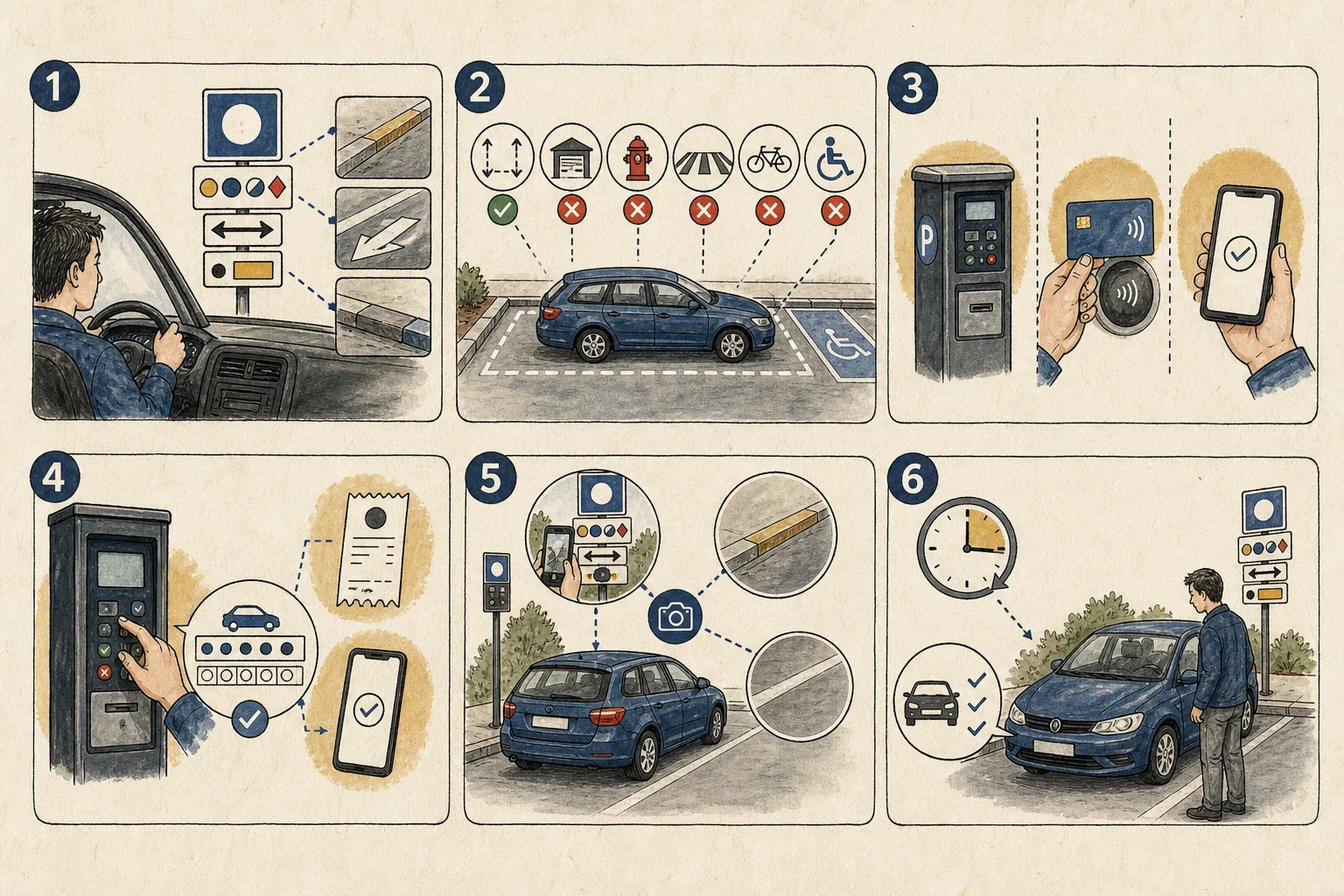
Parking checklist: 1 read the nearest sign, arrows and curb markings together; 2 rule out restricted or obstructive spaces; 3 identify the accepted payment method; 4 record the correct vehicle or bay and keep confirmation; 5 photograph the sign and parked position; 6 return before expiry. Colors have no universal meaning. Click to enlarge.
Pay-and-Display and Parking Apps
Pay-and-display: Buy the ticket for the correct plate or bay, check the printed expiry and display it exactly as instructed. Some cities use a receipt in the windscreen; others use plate recognition and require no paper. A machine accepting your card does not prove that the payment was linked to the right vehicle.
Parking apps: Apps like EasyPark, ParkMobile, and RingGo work in many European cities. You enter your license plate and pay by phone: no need to return to the car to extend. Check if your destination country supports your preferred app before you arrive.
Zone or plate entry: Enter the zone, bay or registration exactly as shown. Photograph the machine screen and keep the receipt or app confirmation. If the machine is out of order, look for the stated alternative; do not assume a broken machine makes the bay free.
 Payment evidence should show the time, location and vehicle details. Photo via Wikimedia Commons.

Underground Garages and Park & Ride
Underground garages: Often the safest and most convenient option in city centers. Take a ticket at entry, pay at exit (card usually accepted). Height restrictions apply: check your rental car’s roof if you have a roof box. Some garages have tight turns; take it slow.
Park & Ride: Many cities offer cheap or free parking on the outskirts with tram or bus connections to the center. Saves money and stress. Look for “P+R” signs.
Wheel Clamps and Towing
Wheel clamps (boots): Some authorities use them for restricted or unpaid parking. Release steps and charges vary; use the number on the clamp or the official notice, not a stranger offering help. Photograph the clamp, bay, sign and time before moving the vehicle.
Towing: Blocking traffic, occupying an accessible bay or ignoring a removal notice can lead to towing. Retrieval normally requires the registration, rental agreement and payment through an official depot. If the vehicle is missing, contact the local police or parking authority and then the rental branch; do not report it stolen before checking the official process.
Prevention: Never park in disabled bays without a valid permit. Avoid bus stops, taxi stands, and loading zones. When unsure, ask a local or find a paid garage.
Common Mistakes to Avoid
- Ignoring time limits: A 2-hour blue zone means 2 hours. Returning late can mean a fine.
- Facing the wrong way: In some countries (e.g., France, Germany), you must park in the direction of traffic flow.
- Forgetting the parking disc: In disc zones, no disc = fine, even if you’re within the time limit.
- Assuming free on Sundays: Rules vary. Some cities enforce parking on Sundays; others don’t.
- Parking in resident zones: Look for permit wording, time windows and plate requirements. A paid app may still be invalid for a resident-only bay.
A two-minute return-proof routine
- Photograph the nearest sign, the bay or curb and the parked vehicle with the plate visible.
- Save the ticket, app receipt or machine error with the location and expiry time.
- Put the return time in the phone calendar, allowing for walking and queueing at the garage.
- On return, check for damage or a clamp before leaving; report a new issue to the rental company while the location is known.
Sources and review date
This tip was reviewed on August 17, 2026. Parking is set by the local authority and can change by street, day, event or vehicle class. Confirm the sign at the bay and the operator’s current payment instructions before leaving the car.
- Your Europe: road rules and safety when driving abroad
- UK Highway Code: waiting and parking rules
- Transport for London: parking and loading restrictions
- European Commission: accessible parking card guidance
For country-specific rules, check the destination guide for your route.