Overview
Australia is a set of different driving environments rather than one uniform road system. A compact city car in Melbourne, a coastal route in New South Wales and a remote gravel road in the Northern Territory require different planning. Road rules are made and enforced by each state and territory, while signs and temporary instructions control the road in front of you.
The basic habit is simple: keep left, look well ahead, and leave a larger time and fuel margin than a map estimate suggests. The left-side driving guide is useful practice before the first rental-car journey.
Licence, translation and rental documents
An overseas visitor needs a current licence that authorises the vehicle class being driven. The exact visitor period and document conditions vary. For example, New South Wales allows a temporary overseas visitor to use a current overseas licence for up to six months, provided the visitor remains eligible and follows NSW rules. That is not a national 3–12 month promise.
Before departure, check all three of these points:
- Carry the original licence. If it is not written in English, carry the translation or IDP accepted by the state or territory. An IDP is a translation document, not a replacement for the domestic licence; the IDP guide explains the distinction.
- Ask the licensing authority about the state where the rental starts and any state crossed later. A long trip can pass through several jurisdictions.
- Ask the rental company whether it requires an IDP, a minimum licence-holding period, a passport, a credit-card deposit or an age surcharge. The rental contract can be stricter than the road rule.
For an overseas licence written in English, an IDP may not be required in every state. Keeping one can still make a roadside document check and a rental counter conversation easier. Do not rely on a digital photograph when the authority or rental contract asks for the original card.
Left-side road position and intersections
On a quiet road, practise the visual sequence rather than memorising slogans:
- The driver sits on the right and the centre line is on the driver’s right.
- After turning, return to the left lane before settling the steering.
- At a roundabout, keep left of the central island, obey lane arrows and give way to traffic already in the roundabout. Victoria’s official roundabout guidance is a useful illustrated reference.
- At an unmarked intersection, apply the rule shown in the local road handbook rather than assuming every junction works the same way. Slow down far enough to see cyclists, pedestrians and vehicles hidden by parked cars.
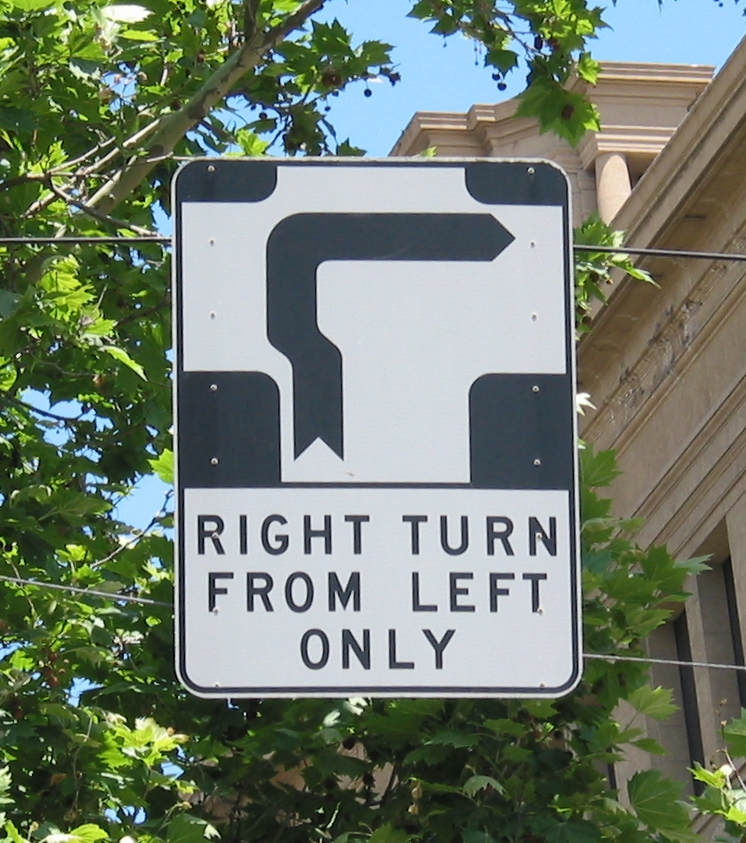
Melbourne’s central business district has signed hook turns. The right turn is begun from the left lane, the car waits in the marked position, and the turn is completed when the crossing signal allows it. Follow the sign and lane arrows; a conventional right turn from the through lane is not a substitute. The sign below is a reminder that this is a local manoeuvre, not a national rule.

Seat belts are required for occupants where a belt is fitted. Never plan to hold a phone at a red light: the legal treatment of phones depends on the licence class and jurisdiction, and NSW and Victoria both impose detailed restrictions. A mounted navigation system still needs to be set before the car moves.
Speed, school zones and fatigue
The number printed on the sign is the legal maximum, not a target. Victoria’s official speed-zone table shows why a road can move between 40, 50, 80, 100 and 110 km/h as the environment changes. NSW also warns that school-zone signs and flashing periods control the lower limit. Read the sign again after every major junction and slow further for heat, rain, dust, animals or poor visibility.
Long straight roads can make a driver feel alert while fatigue is building. Divide the route into stops with shade, water and a driver change where possible. If the route crosses a time zone or begins before sunrise, schedule the first rest before the difficult section rather than after it. A rental-car navigation estimate does not include a safe rest plan.
City tolls and parking
Tolls are electronic in the main city networks. In NSW, all toll roads are cashless; a visitor can use an eMU Casual Pass linked to the rental vehicle’s number plate. A rental branch may instead provide its own tag or transfer every toll to your contract with an administration fee. Photograph the plate and the toll instructions at pickup, then keep the final statement.
Melbourne’s CityLink and EastLink use their own operators, and Brisbane has its own toll network. Check the operator named on the sign or rental agreement. Do not copy a price from an old blog: tolls can vary by road, vehicle class, time and operator. The dedicated Australia toll and city parking guide covers the payment workflow in more detail.
Parking signs are local instructions. Read the hours, ticket or app requirement, resident restrictions, loading zone and clearway wording at the exact bay. Enter the rental plate correctly into an app or meter, and leave enough time to find another space when a street closes for an event. A blank kerb is not proof that parking is free.
Outback routes, road trains and unsealed roads
Remote driving is a logistics problem. Before leaving the last town, check the road authority for the state or territory, the Northern Territory Road Report or the Western Australia travel map, and the weather service. Ask locally about fuel, water, road closures, tyre repairs and whether your rental contract allows the planned track.
Plan a reserve for a missed turn, a detour and a closed service station. Carry drinking water, food, basic first aid, a charged offline map, a working spare tyre and the tools needed to change it. In areas without mobile coverage, a satellite communicator or personal locator beacon may be more useful than a second navigation app. Tell a contact your route and the time you expect to check in.
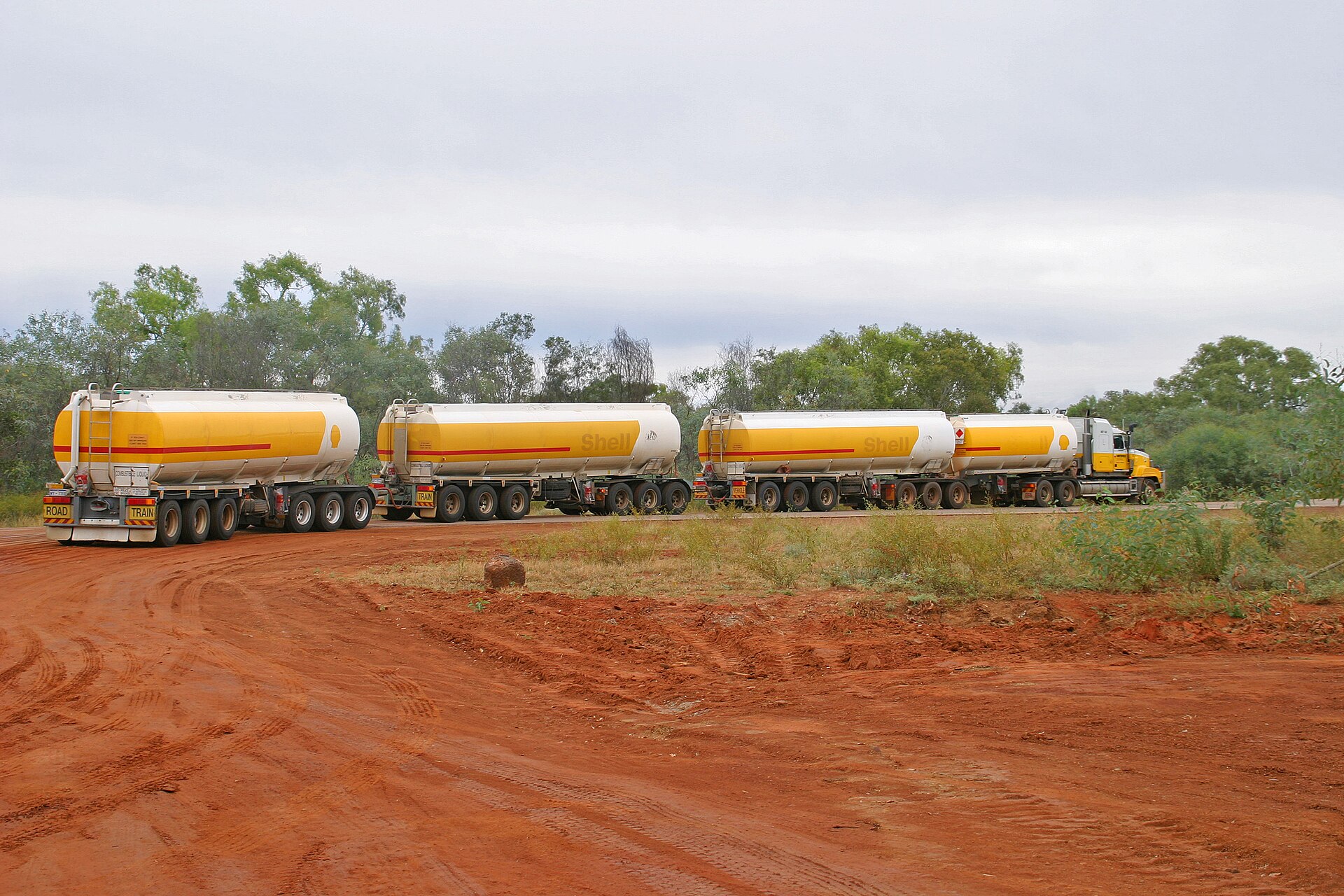
Road trains need room and time. The Northern Territory safety guidance notes that some can be three trailers and around 50 metres long, and advises at least 1 km of clear straight road before overtaking. The image below shows why a short passing gap is deceptive. Reduce speed, keep a steady line, and move completely off the sealed lane only where the road and local instructions make that safe.

On gravel, increase following distance because dust can hide a vehicle and loose stones can damage the windscreen. A 2WD may be suitable for a sealed highway but prohibited on a particular track; a 4WD can still become bogged. Never enter floodwater when the depth, flow, surface or road condition is uncertain. NT emergency guidance specifically warns against crossing flooded bridges and causeways and against treating a 4WD as permission to go anywhere.
Wildlife and changing weather
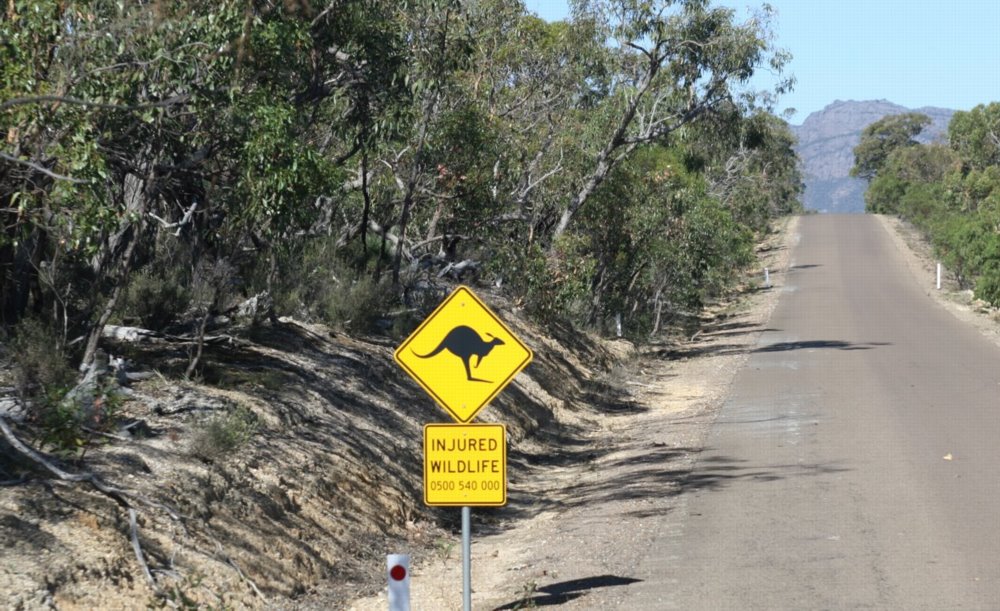
Kangaroos and other animals are most difficult to see around dawn, dusk and at night. Warning signs identify a risk area, not a guarantee that the road is clear. Reduce speed before bends, scan the verges and leave a braking margin. If an animal appears, brake firmly while keeping the vehicle straight when possible. A sudden swerve can put the car into an oncoming lane or a tree.

Heat, bushfire smoke, storms and flash flooding can change the route after a map was downloaded. Check state road closures and fire or flood warnings on the day, and obey a closed-road sign even when a navigation app still draws a line through it. The Australia road-trip safety guide expands the heat, fatigue and fuel checklist.
Fuel, charging and vehicle choice
Use the fuel grade specified by the rental company and confirm whether the vehicle accepts E10. On an outback route, mark the next confirmed fuel stop rather than relying on a chain logo on a map. Keep a margin for detours, air-conditioning use and a station that is temporarily closed. Fuel prices change by place and date, so a fixed national price is not useful planning data.
EV charging is expanding in cities and along selected corridors, but a remote route may have long gaps. Check the vehicle’s real range, charger compatibility, opening hours and an alternative stop. Do not plan the last kilometre to a charger with a nearly empty battery.
Rental contracts often exclude named unsealed roads, beach driving, water crossings, roof loads or travel into another state. Inspect tyres, wheels, windscreen and underbody with the staff member, photograph existing damage, and ask how roadside assistance works outside the city. The rental insurance and damage-check guide explains excess, exclusions and evidence to keep.
Emergency checklist
Call Triple Zero (000) for a life-threatening or time-critical police, fire or ambulance emergency. 112 is a secondary mobile emergency number, but neither number works without network coverage. Give the operator the road name, direction of travel, nearest marker and vehicle details. For a non-urgent breakdown, use the rental company’s assistance number or the relevant state motoring organisation.
Before turning the key:
- confirm the licence, translation or IDP and rental restrictions;
- save the state road report, weather warnings and offline map;
- photograph the vehicle, plate, fuel level and toll instructions;
- set navigation and phone audio before moving;
- carry water, food, a charged power bank and a usable spare tyre;
- share the remote-route plan and a check-in time with someone else.
Official resources and review date
This page was reviewed on 17 August 2026. Licensing periods, mobile-phone rules, speed zones, toll products, road closures and rental exclusions can change. Recheck the state or territory authority before driving:
- NSW overseas-licence rules
- Victoria roundabout rules and speed limits
- NSW toll roads and toll notices
- Northern Territory personal safety and road trains
- Western Australia regional and long-distance driving
- Triple Zero emergency numbers
Related destinations
Frequently Asked Questions
- Can a visitor drive in Australia with a foreign licence?
- Usually, if the licence is current and the visitor follows the rules of the state or territory being visited. A licence that is not in English must normally be carried with an approved English translation or an International Driving Permit. Check the licensing authority and the rental branch before collecting the car.
- What should I remember about driving on the left?
- Keep the car to the left, expect the driver to sit on the right, and take extra care after every stop. At a roundabout, give way to vehicles already circulating and follow the lane arrows. Right turns cross oncoming traffic, so practise the sight lines before leaving the city.
- Are speed limits the same across Australia?
- No. States and territories set their own rules and signs control the road. Built-up areas commonly use 50 km/h and many rural roads use 100 km/h, but school, work, variable and special zones can be lower. Treat the signed limit as a maximum for good conditions.
- Can I use my phone while driving?
- The details differ by licence class and jurisdiction, but handheld use is unsafe and commonly illegal. Set navigation before moving, use only a legally mounted system where permitted, and pull over in a safe parked position before touching the phone.
- How do toll roads work in Australian cities?
- Sydney, Melbourne and Brisbane use electronic tolling. A rental car may have a tag or plate-based service, or you may need to open a visitor account. Confirm the operator, vehicle plate and administration fees at pickup; never assume a cash lane exists.
- What preparation is needed for an outback drive?
- Check the relevant road report and weather warnings, tell someone your route, and carry more water, food and fuel margin than the map suggests. Confirm tyre condition, spare-wheel equipment and access rules for every unsealed section. A 4WD does not make floodwater safe.
- What should I do if wildlife appears on the road?
- Slow down in wildlife areas, especially around dawn, dusk and night. Brake in a straight line when possible and avoid a violent swerve into another lane. If there is a crash or injury, stop safely and call Triple Zero on 000 when urgent help is needed.
Information Sources & Disclaimer
This guide compiles information from the official transport authorities, road operators, government travel information, and automobile associations linked for Australia.
While we strive to keep this information as accurate and up-to-date as possible (last reviewed: August 2026), traffic laws and toll rates can change without notice. We recommend verifying critical information with the local authorities or your car rental agency upon arrival.
Learn more about our Editorial Process →Compare Your Origin and Destination
Use the comparison tool to check driving side, units, documents, and other destination data for your route.