Choose the road before choosing the car
Bolivia is not one driving environment. La Paz and El Alto are steep, dense and high. The altiplano links long paved corridors with cold, wind and few dependable services. Uyuni adds a boundary between public roads and salt-flat travel that is usually operated in a local 4x4. The North Yungas road is an adventure route with a very different risk profile. A route that looks continuous on a map can cross several rental-contract exclusions in one afternoon.
Traffic keeps to the right and the standard unit is kilometres per hour. Carry the physical documents, inspect the vehicle in daylight and build every remote stage around fuel, daylight, weather and a point where you can turn around. The Bolivian Police’s current national-norms page links the Traffic Code and regulation; the official Traffic Code PDF is the legal reference used for the licence and vehicle-document sections below.

Licence, IDP and the rental counter
Carry the original licence and a translation document
Bolivia’s Traffic Code defines an international driving permit as the document that authorises driving in foreign territory and says a foreign-issued permit is admitted after identifying its holder. That does not remove the need for the original national licence. The safest pickup set is the physical licence, a physical IDP if your issuing authority provides one, passport, booking and payment card.
The rule can look different at a rental counter. The Embassy of Japan in Bolivia reports that short-term Japanese visitors need a Japanese-issued IDP or a Bolivian provisional licence and that a Japanese licence alone is not enough. The UK government’s Bolivia guidance says UK drivers should carry both a 1949 IDP and their UK licence. These examples explain why this page uses a conservative idpRequired value while still telling you to confirm your own issuing jurisdiction with the named branch.
An IDP is a translation companion, not a replacement for the original licence. Send a scan of both sides to the branch before paying when the licence is not in Spanish or Latin script, the category is unclear, or the booking site gives a generic document list. Ask the branch to reply in writing with the accepted IDP convention, minimum licence-holding period, named-driver rule and whether a certified Spanish translation is accepted instead.
Legal age is not rental age
The Traffic Regulation sets 18 as the minimum age for a private-driver licence. Rental requirements are commercial conditions. Hertz Bolivia’s terms describe 25 as the normal minimum and an economy-category exception for ages 21–24 with a daily surcharge. The Europcar Bolivia terms, dated 1 June 2026, describe 21 for most categories and separate city-car young-driver rules from 18.
Before signing, ask for the exact vehicle group, young-driver fee, minimum licence tenure, deposit, credit-card requirement, extra-driver documents, permitted road surface and roadside recovery. A large SUV is not automatically a 4x4, and a 4x4 is not automatically covered on salt, river or unauthorised roads.
At collection, photograph the plate, registration, bodywork, glass, tyres, spare wheel or repair kit, fuel or charge level, odometer and dashboard warnings. Ask where the SOAT certificate, rental authorisation and roadside number are stored. Keep a copy of the signed inspection sheet in the phone and offline.
Right-side traffic, speed limits and sign priority
The codified baseline
The regulation’s baseline is lower and more surface-specific than a generic “highway speed” label suggests:
| Road context | Baseline in the regulation | Practical interpretation |
|---|---|---|
| School or military zone | 10 km/h | The regulation describes a zone extending 50 m before and after the access point. A sign, officer or temporary order may be stricter. |
| Busy urban street | 20 km/h | Use the lower speed where pedestrians, minibuses, market activity or parked cars reduce sight distance. |
| Avenue where safety allows | 30 km/h | Do not turn this into a target on a steep, crowded or wet La Paz street. |
| Paved road outside towns | 80 km/h | The road sign, police direction, construction and surface condition control. |
| Gravel or dirt road outside towns | 70 km/h | Treat this as a legal ceiling baseline, not a promise that a rental car or tyre is suitable. |
Article 116 permits the Traffic Police to increase or reduce the listed limits at particular places through corresponding signs. Article 143 gives a police officer’s directions priority when the officer acts at the same time as a signal or other sign. Read the posted sign and the officer first, then reduce further for rain, fog, loose rock, blind crests, pedestrians, animals, traffic or an exposed drop.
Keep right, overtake on the left only with a clear view, and do not pass at a blind bend, crest, junction or narrowing. Use belts for every occupant, settle the navigation before moving and treat a crowded minibus stop as a hazard rather than an invitation to squeeze through. On a descent, choose a gear that controls speed without riding the brakes.
City exits and mountain entries
La Paz’s urban grid can make a five-kilometre exit slow. Save the hotel entrance offline, confirm whether the route enters a restricted or one-way block and do not let a navigation app send a rental into a stair-like lane or an unpaved shortcut. Once the road leaves the basin, check fuel, cooling, spare-wheel condition and daylight before committing to a pass or a valley descent.
La Paz: altitude, gradients and parking
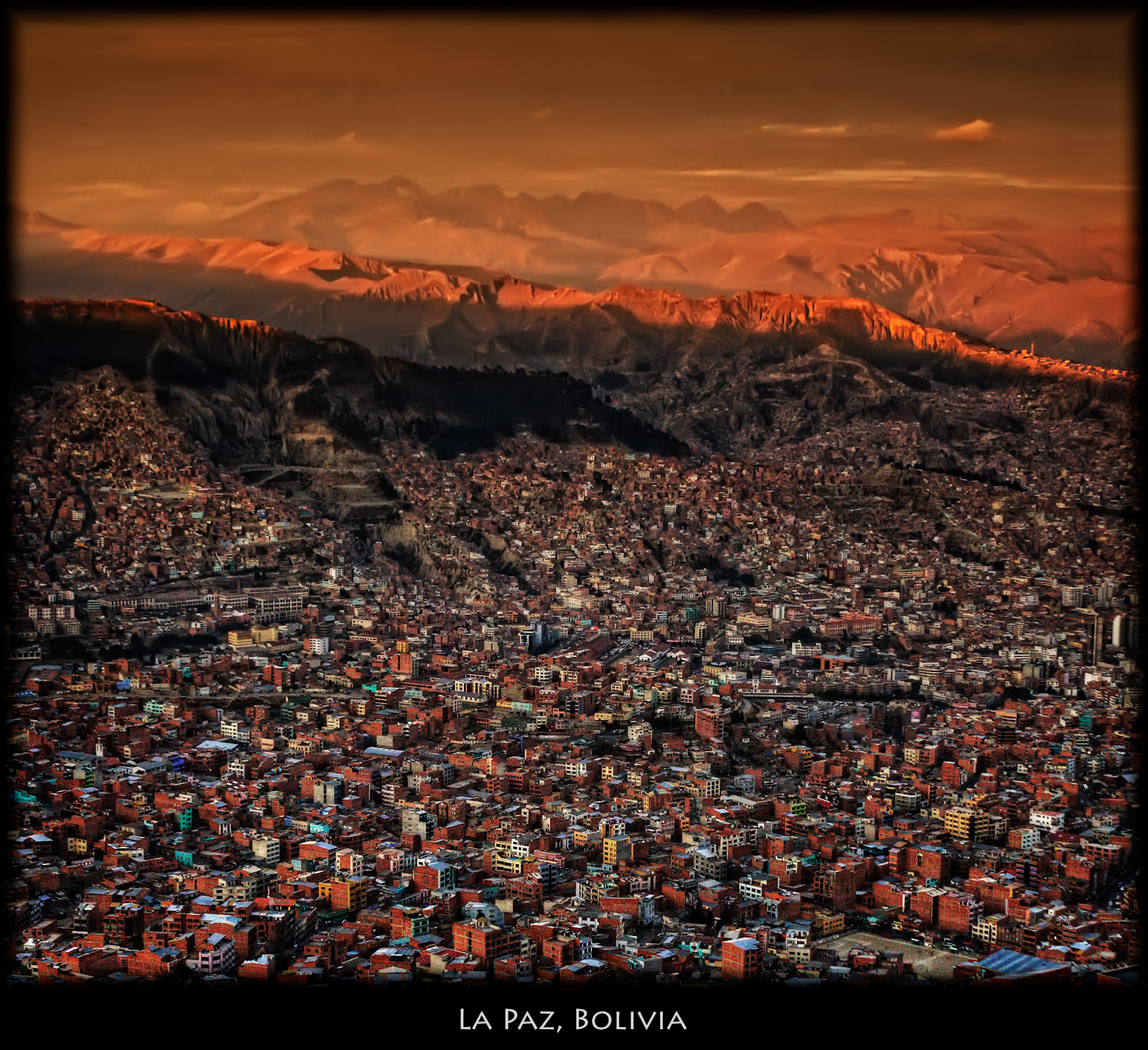
The municipal geological report places the historic centre around 3,640 m above sea level and describes the urban municipality as extending from roughly 3,200 m to more than 5,300 m. At this elevation, a visitor’s first city drive should be short and deliberate. Plan a slow arrival, keep water and warm layers in the car, avoid a long same-day mountain excursion after a late flight and stop if a driver or passenger feels unwell. The car is not a substitute for acclimatisation or medical advice.
The La Paz municipality parking notice dated 23 July 2026 says the municipality is implementing a new tariffed-parking model. It says operating areas and payment details are being defined through technical studies, describes 743 spaces and sets out 5.5 m bays. That is a useful current signal, not a universal city rate card. Read the sign on the exact block, use a hotel garage or supervised lot, keep the session or receipt, and never double-park on a steep street or block a garage, bus stop, ramp or emergency access.
Hertz’s published terms also contain a separate plate-based restriction for entry to central La Paz. That is a rental-company condition, not a national traffic rule. Ask the branch whether the assigned plate, pickup time and return route can enter the central zone before leaving the airport or office.
Route decisions: five plans with different boundaries
| Plan | Choose it when | Vehicle and operating boundary | Turn back when |
|---|---|---|---|
| La Paz city + Tiwanaku or the lake corridor | You want a short cultural first stage after arriving at altitude. | Use a compact car only if the pickup, garage and confirmed public road are straightforward; start in daylight and leave parking outside the busiest blocks. | A driver feels unwell, the city exit is blocked, or the lake forecast and road report do not support the return. |
| Sucre–Potosí–Uyuni highland line | You want a paved-road backbone with high-altitude towns and a later Uyuni base. | Choose a contract-compliant vehicle with a full tank, spare/recovery check and an overnight plan; verify each segment with ABC rather than estimating from a map. | Fuel is uncertain, ABC shows a closure, a blockade is forming, or the daylight margin disappears. |
| Uyuni town / Colchani boundary | You want to reach Uyuni and decide locally whether to join a salt-flat trip. | Keep the rental on the public-road portion that the contract names. Confirm local access, salt, water and insurance exclusions in writing. | A contract excludes dirt or salt, visibility or water changes, or the operator cannot confirm vehicle, driver and recovery arrangements. |
| Salar de Uyuni and coloured lagoons | The salt flat is the main objective rather than a quick roadside stop. | Use a reputable local 4x4 operator and ask what is included: driver, spare wheels, fuel, route, weather cancellation, emergency contact and passenger insurance. | The operator cannot state the current route or recovery plan, or the salt/water conditions make the track unclear. |
| North Yungas / Death Road | You specifically want the adventure experience and have a current operator plan. | Treat the official tourism framing as mountain biking and adventure travel; do not repurpose a standard rental car without written motor-access, insurance and road-status confirmation. | Rain, rockfall, fog, a missing guide or an unclear road closure removes the safety margin. |
These are decision boundaries, not guaranteed itineraries. The Bolivian tourism ministry’s adventure page describes the Death Road as an approximately 80 km route from La Cumbre toward Yolosa and highlights biking. Its La Paz tourism material places the Yungas, Titicaca and La Paz in the same regional destination but does not turn every connecting track into a rental route.


Uyuni and the salt-flat boundary
The road to Uyuni and the salt surface are separate decisions. A navigation line can remain visible after pavement ends, but that does not prove that a rental contract, insurer or recovery provider covers the next surface. The Ministry of Tourism’s programme material describes Salar visits in a 4x4 with a driver. The Europcar Bolivia terms dated 1 June 2026 list “equipment for the entrance to the Salar de Uyuni” as an additional service and state in their circulation section that dirt roads, unauthorised roads, lagoons and rivers are prohibited under the ordinary terms.
That Europcar wording is an operator example, not a national ban. It does show the question to ask: “Does this exact registration, insurance product and driver have written permission for the Salar, the current access road, water crossings and coloured-lagoon route?” If the answer is not written, leave the rental in Uyuni or at the agreed public-road base and join a local 4x4 trip. Confirm the operator’s current registration, driver experience, spare wheels, fuel plan, weather cancellation rule, passenger cover and emergency contact locally; the UK government notes that adventure operators in Bolivia do not have official minimum standards.
Avoid driving onto wet salt, standing water or a track that has disappeared into glare. Keep offline maps, a paper contact and an agreed return time, but do not treat a GPS track as a rescue plan. In the dry season, dust and glare still affect visibility. In the wet season, the surface can change the access decision without matching a road closure on a national highway map.
Death Road, mountain roads and rain
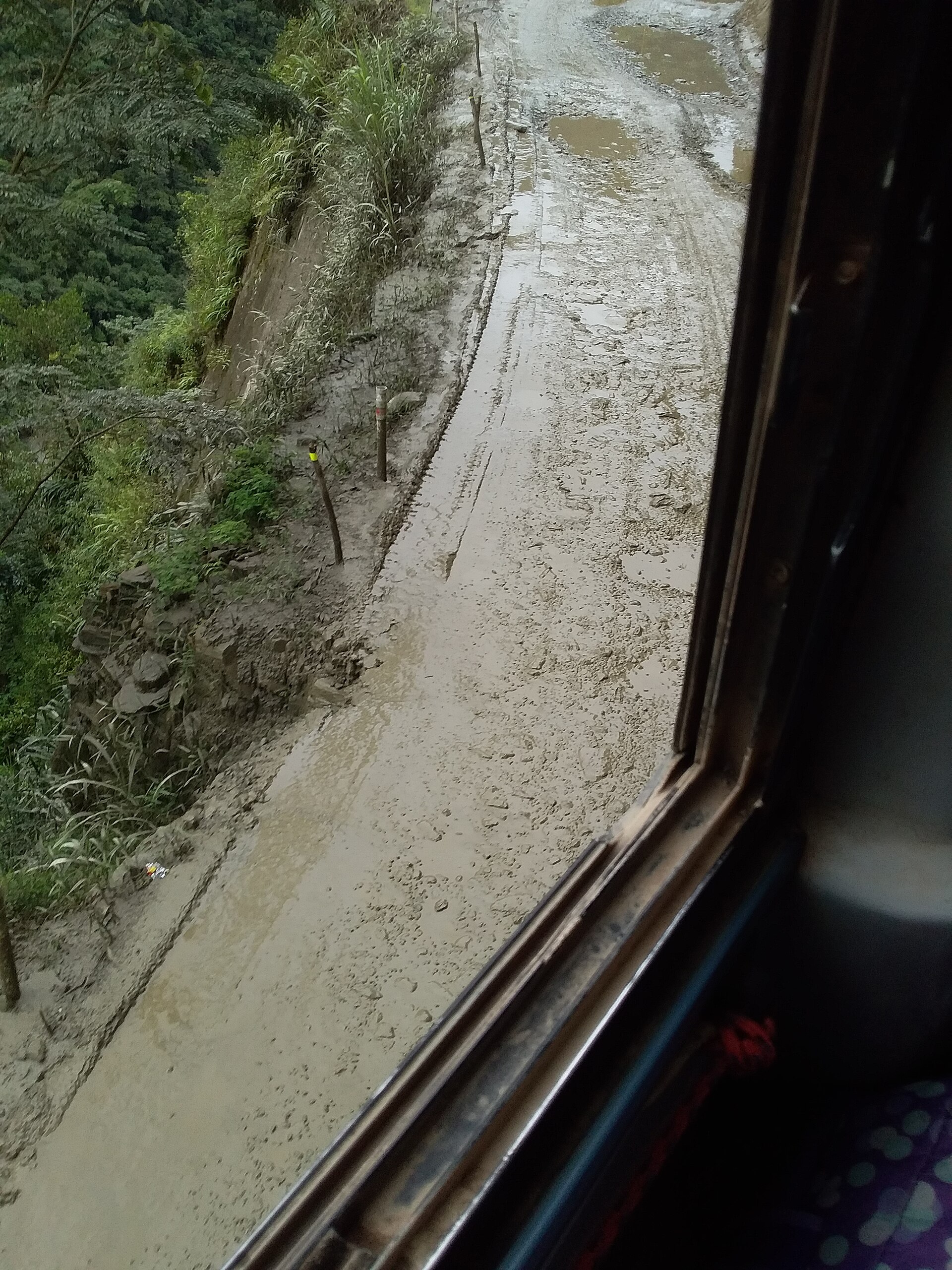
The old North Yungas road is narrow, steep and exposed. The official tourism page promotes it as a mountain-biking activity, and the UK travel guidance specifically advises checking the bike, guide, safety equipment and first-aid kit. For a visitor arriving with a rental car, the useful boundary is simple: do not assume a normal urban or inter-city contract covers a road used for adventure cycling. Ask the operator about motor access and the rental company about road, tyre, underbody and recovery exclusions before making the detour.
On any mountain road, keep the vehicle in a gear that controls the descent, leave room for oncoming traffic, avoid stopping at blind corners and never reverse toward an unprotected edge without a spotter. Rain can bring mud, falling rock, fog and a changed river or drainage crossing. If you cannot see the exit from a bend or the surface no longer supports the vehicle, turn around while there is still room.
Official travel guidance describes November–March as the rainy season and warns of landslides and blocked roads. The season is not a national “closed” period: check the ABC road authority and its live transitability service for the exact segment. A road can be technically open while a fresh slide, protest or fuel shortage makes a tourist stage unreasonable.

National roads, tolls and blockades
The Administradora Boliviana de Carreteras (ABC) describes transitability certification for a specific section of the Red Vial Fundamental. Use the live service immediately before departure and again before a remote return. Check the route name, direction, closure, detour, works, rain damage and any notice about social conflict. Save a screenshot because signal can disappear after the city exit.
Road conditions involve more than the surface. Bolivia can have social blockades, roadworks, rockfall, flooding and fuel queues. Do not drive through a line of people or a makeshift barrier. Turn around before the queue becomes a trapped overnight stage, contact the hotel or operator, and ask ABC or local authorities for the current alternative. A bus or taxi taking a route is not proof that a rental car has the same clearance, insurance or permission.
Vías Bolivia administers tolls and weighing on the Red Vial Fundamental. The official Vías Bolivia page describes the Televías tag and the Gob.bo entity page describes the public toll function. Tariffs, stations, exemptions and electronic coverage can change. Keep Bolivianos for a physical lane, ask whether a rental plate or tag is already billed to the company, and photograph the receipt or note the station and time.
Fuel, payments and electric charging
Fuel is a route constraint
The ANH price page publishes current 2026 fuel tables and the ANH station information lists stations and fuel types. YPFB Refinación’s distributor page is another useful check for city service locations. Official travel advice has warned of petrol and diesel shortages and long queues, so fill before the gauge becomes a problem rather than after reaching the last marked station.
Ask the rental desk to identify the exact fuel label in Spanish, the tank capacity, the nearest dependable station for each stage and what happens if a station accepts only cash. ANH maintains a separate international-price framework for vehicles with foreign plates; the foreign-plate information is relevant to a visitor bringing a private car across a border, while a Bolivia-plated rental is a different documentary situation. Confirm the plate and payment treatment at the station and with the rental company.
EVs need a fallback
The Ministry of Hydrocarbons and Energy notice dated 4 November 2024 reported more than 10 public electrolineras in La Paz, Oruro, Cochabamba and Santa Cruz. It did not establish a dependable remote network at Uyuni, the Salar or the North Yungas. Before booking an EV, get live confirmation of the connector, charging speed, opening hours, payment method, access permission and overnight electricity. A petrol itinerary, shorter stage or confirmed hotel charge is the fallback, not a hope that a map pin will be live.
Documents, SOAT and what to do after an incident
Keep these together in a waterproof folder or sealed pouch:
- physical national licence and physical IDP when applicable;
- passport and entry record;
- rental contract, named-driver authorisation and credit-card roadside instructions;
- vehicle registration or ownership document and insurance certificate;
- current SOAT certificate and the insurer’s claim number;
- ABC route screenshot, hotel/operator contact and emergency numbers;
- written cross-border, Salar or special-road permission when relevant.
The APS insurance regulator’s FAQ says every motor vehicle travelling in Bolivia must have SOAT. The SOAT regulation identifies the certificate as the document carried in the vehicle to evidence cover. SOAT is compulsory traffic cover; it does not replace the rental company’s collision, theft, underbody, tyre, recovery or cross-border conditions.
| Situation | First action | Then |
|---|---|---|
| Injury, fire or immediate danger | Call 110 and state road, direction, landmark, plate and hazards. | Follow the dispatcher’s instruction; use the rental recovery line when people are safe. |
| Traffic incident without immediate injury | Call 111 for the Organismo Operativo de Tránsito. | Notify the rental company, preserve the accident record and photograph safely. |
| La Paz ambulance need | Call 167 for the municipal ambulance network. | Give the exact zone, nearest street or landmark and access problem. |
| Non-dangerous breakdown | Move clear of traffic if possible, hazards on, people away from the carriageway. | Call the rental’s 24-hour or roadside number; do not improvise a tow on a mountain track. |
| Road closure or blockade | Do not cross the barrier. | Check ABC, ask local authorities or the operator, and activate the turn-back or overnight plan. |
The current Bolivia Police website lists BOL-110/110 for police emergencies and 111 for the traffic organisation. The La Paz municipal parking notice lists 167 for its ambulance network and 114 as a local emergency line. Numbers and coverage can change by department; save the rental number and the local hotel contact as well.
Spanish phrases for the road
| English | Spanish |
|---|---|
| Is the road open? | ¿La carretera está abierta? |
| Is there a roadblock? | ¿Hay bloqueo? |
| Can we pass? | ¿Hay paso? |
| Where is the fuel station? | ¿Dónde está la gasolinera? |
| Do you accept cards? | ¿Aceptan tarjeta? |
| How much is the toll? | ¿Cuánto cuesta el peaje? |
| Where can I park legally? | ¿Dónde puedo estacionar legalmente? |
| I need a tow truck. | Necesito una grúa. |
| The car has a warning light. | El auto tiene una luz de advertencia. |
| Please send the location to this pin. | Por favor, envíe la ubicación a este punto. |
In this context, bloqueo means a road blockade, not simply slow traffic. Show the map pin, road number or nearby town, and ask the same question at a fuel station, hotel and operator office rather than relying on one answer.
Sources and review date
This page was reviewed on 18 August 2026. The legal baseline was checked against the Bolivian Police national-norms page and the official Traffic Code PDF. Foreign-driver boundaries were checked against the Embassy of Japan in Bolivia, the UK government’s Bolivia safety guidance, and the published Hertz Bolivia terms, Avis Bolivia terms and Europcar Bolivia terms dated 1 June 2026. The last two companies do not publish identical rules; the signed contract controls.
SOAT was checked against the APS FAQ and SOAT regulation. Road status and tolls were checked against the ABC road-authority tool page, ABC live transitability service, Vías Bolivia and Gob.bo’s Vías Bolivia record. La Paz altitude was checked against the municipal geological report, and parking against the 23 July 2026 municipal notice.
Uyuni and Yungas context was checked against the Bolivian tourism ministry’s Salar page, adventure-tourism page, La Paz tourism page and its photographic catalogue. Fuel and charging were checked against the ANH 2026 price table, ANH station information, ANH foreign-plate information, YPFB Refinación distributors and the 4 November 2024 electromobility notice.
The three photographs are individually credited in their captions and manifest: La Paz, Bolivia (4105223814).jpg, Salar de Uyuni 12.jpg, and Carretera de la muerte .jpg. Recheck licences, IDP acceptance, rental category, road status, fuel, parking, border paperwork, Salar access and emergency coverage for the travel date.
Related driving resources
Frequently Asked Questions
- Does Bolivia drive on the left or the right?
- Bolivia drives on the right. The traffic regulation says vehicles must keep to the right and overtake on the left. Read the lane arrows, centre lines and local signs rather than assuming a wide road has the same priority at every junction.
- What are Bolivia's baseline speed limits?
- The codified regulation gives 10 km/h in school or military zones, 20 km/h on streets with intense pedestrian and vehicle traffic, and 30 km/h on avenues where safety permits. Outside towns it gives 80 km/h on paved roads and 70 km/h on gravel or dirt roads. A posted or police-directed limit can raise or lower those baselines, and the safe speed can be lower again for altitude, rain, fog, traffic or a narrow surface.
- Do foreign visitors need an International Driving Permit in Bolivia?
- Plan to carry a physical IDP together with the original national driving licence and passport. Bolivia's Traffic Code admits a foreign-issued international permit after identifying its holder, while official travel and embassy guidance can be stricter for particular issuing jurisdictions. The rental counter may also set its own document rule. Confirm the exact IDP convention and language requirement with the named rental office before payment.
- Is my national driving licence alone enough?
- Do not rely on a national card alone when it is not in Spanish or Latin script, does not clearly show the vehicle category, or your rental operator asks for an IDP. Japan's embassy guidance says a short-term Japanese visitor needs a Japanese-issued IDP or a Bolivian provisional licence; the UK travel guidance says UK drivers need both a 1949 IDP and their UK licence. Those are jurisdiction-specific examples, not a universal substitute for checking your own licence.
- What is the legal minimum driving age in Bolivia?
- The Traffic Regulation sets 18 as the minimum age for a private-driver licence. A rental company's handover age can be higher and can change by vehicle class, licence history, deposit and additional-driver status. The signed rental contract controls the car you collect.
- What rental age rules should I expect?
- Published operator terms are not uniform. Hertz Bolivia lists 25 as its normal minimum and an economy-category exception for drivers aged 21–24 with a daily surcharge. Europcar Bolivia terms dated 1 June 2026 list 21 for most categories and separate young-driver rules for city cars from age 18. Treat those as operator examples, not national law, and ask for the exact category, surcharge and licence-tenure rule in writing.
- Which vehicle category suits a Bolivia road trip?
- A city car or sedan can suit a confirmed paved urban or inter-city plan. A higher-clearance SUV or 4x4 can make a rough or wet stage more manageable, but it does not automatically include gravel, salt, river or off-road cover. A local 4x4 with a driver is the safer boundary for the Salar de Uyuni and remote coloured-lagoon routes. Match the vehicle, tyres, spare wheel, recovery plan and contract to the exact road.
- Is La Paz altitude a driving issue?
- The urban centre of La Paz is approximately 3,640 m above sea level, according to a municipal geological report. Steep streets, stop-start traffic, exposed descents and altitude can make a first driving day tiring; the vehicle may also feel different on climbs. Use a garage or supervised lot, take a short first stage in daylight, check the brakes and cooling system, and stop driving if anyone is unwell. Altitude acclimatisation is not guaranteed by a car itinerary.
- How should I park in La Paz?
- Park only where the exact kerb sign, marked bay or garage permits it. The municipality announced a new tariffed-parking model on 23 July 2026, with the operating areas, payment method and detailed implementation still subject to municipal studies; the notice describes 743 spaces and 5.5 m bays. Do not carry an old app, rate or informal attendant's instruction to another block. A hotel garage or edge-of-centre car park is usually easier for a rental car.
- Can I drive from La Paz to Uyuni in a rental car?
- You may be able to drive the public road to Uyuni with a suitable, contract-compliant vehicle, but the route is a high-altitude long-distance stage rather than a quick transfer. Check ABC's current status, fuel availability, daylight, roadworks and any blockades before leaving. Confirm in writing whether your rental permits the exact paved, gravel or local access roads; do not infer permission from a route shown in a navigation app.
- Can I drive my rental car across the Salar de Uyuni?
- Do not enter the salt surface in an ordinary rental car unless the signed contract, insurer and operator explicitly name the Salar and its current access conditions. The official tourism material presents Salar visits with 4x4 transport, and Europcar Bolivia's terms dated 1 June 2026 list Salar-entry equipment separately and prohibit dirt roads, unauthorised roads, lagoons and rivers under its normal circulation terms. Keep the rental on the agreed public-road section and use a reputable local 4x4 operator for the salt flat.
- Is the Death Road a normal self-drive route?
- Treat the North Yungas or Death Road as a specialist mountain and adventure route, not as a scenic rental-car shortcut. Bolivia's tourism ministry presents the route primarily as an approximately 80 km mountain-biking descent from La Cumbre to Yolosa, while official travel advice recommends a reputable operator and safety equipment. Ask the rental company and local operator about current motor access, road status, insurance and recovery; do not assume a standard rental policy covers it.
- When is Bolivia's rainy season for road planning?
- Official UK travel guidance describes November through March as the rainy season, when landslides and blocked roads are more likely. That is a planning window, not a closure calendar. Check the exact route on ABC's transitability service on the day of departure, ask locally about fresh rain or a blockade, and keep a turn-back or extra-night option.
- Are Bolivia's national roads paved and reliable?
- Major corridors include paved sections, but surface, maintenance, rockfall, flooding, construction, social blockades and fuel availability can change the practical route. ABC's transitability service is the current check for the Red Vial Fundamental; a map line or a recent traveller report is not proof that a segment is open. Never cross a barrier or a blockade, and do not plan a remote stage around the fastest map estimate.
- Does Bolivia have toll roads?
- Vías Bolivia administers toll collection and weight control on the Red Vial Fundamental. Tolls and exemptions follow current tariffs and stations; the Televías electronic system is being expanded and a rental car may not have a tag. Carry small Boliviano notes, ask the rental desk which lane and billing process apply, and keep any receipt until the deposit and post-rental charges are settled.
- How should I plan fuel in Bolivia?
- Start every long altiplano or mountain stage with a full tank and a second confirmed stop. ANH publishes current fuel prices and station information, while official travel advice has warned of petrol and diesel shortages and long queues. Ask whether the vehicle takes gasolina or diésel, whether the rental plate affects the transaction, and whether card payment is working at the next station. Do not treat a station pin as proof of stock or opening hours.
- Is an electric vehicle practical for Uyuni or the highlands?
- An EV is a city-only or carefully confirmed short-stage choice unless you have live confirmation from the vehicle provider and each overnight stop. A government notice dated 4 November 2024 reported more than 10 electrolineras in La Paz, Oruro, Cochabamba and Santa Cruz; that does not establish reliable charging at Uyuni, the Salar or remote passes. Confirm connector, access, payment, uptime and a petrol or shorter-route fallback before booking.
- Can a Bolivia rental car cross into Chile, Peru, Argentina or another neighbour?
- Never assume it can. Hertz Bolivia's published terms allow only Argentina, Chile and Peru with advance permission, fees and paperwork; Europcar Bolivia's terms dated 1 June 2026 list Peru, Chile, Argentina, Brazil and Paraguay subject to availability and an advance process. These operator policies differ. Obtain a written country list, border dates, vehicle authorisation, insurance territory, third-party cover, fees and return plan before paying.
- What vehicle documents should I carry?
- Carry the physical licence, IDP when applicable, passport, rental contract, vehicle registration or ownership document, insurance details, current SOAT certificate, emergency and roadside numbers, and any written border or special-road authorisation. APS says all motor vehicles travelling on Bolivia's territory must have SOAT and its certificate should evidence the cover. Ask the rental desk to show you the documents rather than assuming they are in the glovebox.
- What should I do after a crash or breakdown?
- Put people in a safe position, use hazard lights and call the relevant emergency service before moving evidence or negotiating damage. Give the road, travel direction, nearest settlement or marker, vehicle plate and hazards. Then call the rental company's roadside number, follow its accident procedure and photograph the scene only from a safe place. Do not leave a remote vehicle on foot in rain, cold or darkness without local instructions.
- Which emergency numbers should I save?
- Bolivia's current police site lists BOL-110 and 110 for police emergencies and 111 for the Organismo Operativo de Tránsito. La Paz's municipal notice lists 167 for its ambulance network and 114 as a local emergency line. Save 110 and 111 nationwide, add 167 when based in La Paz, and keep the rental company's own recovery number because routine breakdown support is not the same as an emergency dispatch.
- What Spanish phrases help at a fuel stop or road closure?
- Useful phrases include “¿Hay paso?”, “¿La carretera está abierta?”, “¿Dónde está la gasolinera?”, “¿Aceptan tarjeta?”, “¿Cuánto cuesta el peaje?”, “¿Dónde puedo estacionar?”, and “Necesito una grúa”. “Bloqueo” means a road blockade; ask before approaching a stopped line of vehicles. A short Spanish question and a saved map pin are often more useful than a precise arrival estimate.
Information Sources & Disclaimer
This guide compiles information from the official transport authorities, road operators, government travel information, and automobile associations linked for Bolivia.
While we strive to keep this information as accurate and up-to-date as possible (last reviewed: August 2026), traffic laws and toll rates can change without notice. We recommend verifying critical information with the local authorities or your car rental agency upon arrival.
Learn more about our Editorial Process →Compare Your Origin and Destination
Use the comparison tool to check driving side, units, documents, and other destination data for your route.