Plan the road around the destination
Switzerland is compact on a map, but a route from Basel or Zurich to an Alpine valley can combine a busy motorway, a tunnel queue, a narrow village street and a high pass in one day. Choose the road environment before choosing the car. City hotels with a garage and a rail connection often make the first and last nights easier; the rental becomes more valuable once the itinerary leaves the main rail corridors.
The four checks that prevent most surprises are separate: buy or verify the motorway vignette, read the parking sign at the actual space, check the live pass and weather status, and ask the rental branch what winter equipment is fitted. A navigation app can estimate time, but it cannot turn a closed pass into an open one.
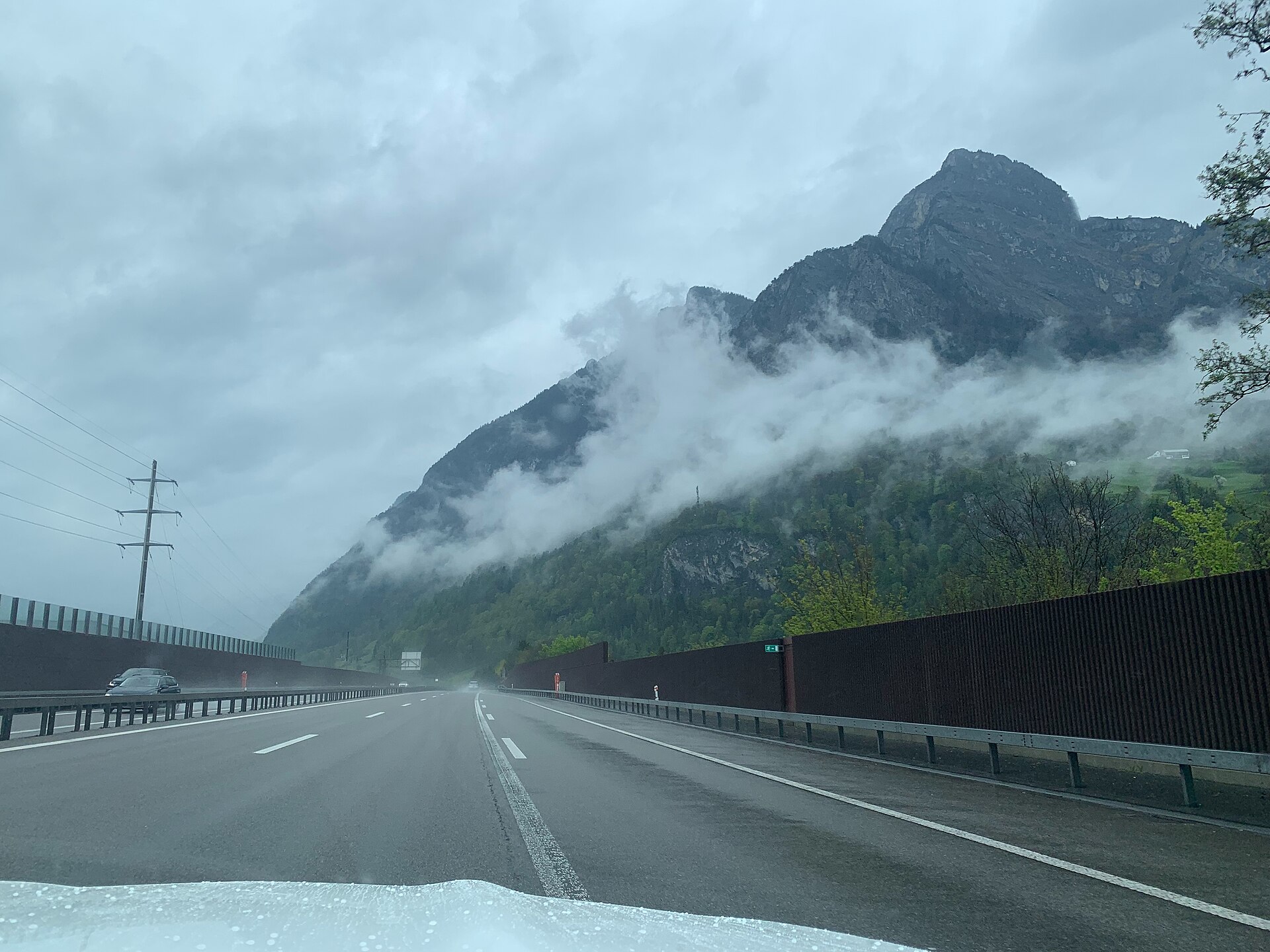

Licence, IDP and the rental handover
The Swiss government guidance for foreign licences says a visitor may drive with a valid national licence or an international licence carried with the matching national licence. If the national document cannot be read in German, French, Italian or English, carry an official translation. An IDP is a translation document, not a replacement for the domestic licence. The Swiss foreign-licence guidance also distinguishes visitors from people who have lived in Switzerland for more than 12 months.
Send the rental branch a scan of the licence, issuing country, vehicle class and any translation before paying. Ask the branch to name the documents accepted by its insurer, and keep the reply with the reservation. At the desk, carry the original licence, passport or identity document, rental agreement and insurance details. Check the fuel or charge level, tyres, windscreen, wheels and underbody, then photograph the vehicle and odometer before leaving.
The legal minimum age for a Swiss passenger-car licence is 18, but a rental company may require 21 or 25 and charge a young-driver supplement. A compact car is easier on village lanes and parking ramps; an automatic or a larger SUV is not automatically better on a narrow pass. Confirm cross-border permission if the route enters France, Italy, Germany, Austria or Liechtenstein.
Rules that matter on the first kilometre
- Keep right and read the sign: overtake on the left, expect trams and bicycles in towns, and give priority according to the sign or road marking. A yellow diamond marks a priority road; an unsigned junction is not a reason to accelerate through it.
- Use the displayed speed: the general limits are 50 km/h in built-up areas, 80 km/h outside them, 100 km/h on expressways and 120 km/h on motorways. The Swiss speed-limit guidance explains the categories and the consequences of larger excess speeds; temporary tunnel, weather and work-zone signs control.
- Lights: motor vehicles must use daytime running lights, dipped headlights or the light prescribed for the vehicle. Automatic daytime running lights satisfy the daytime rule on a suitable car; the law does not mean that full dipped beams must be used in every daylight situation. Switch to dipped beams in darkness, poor visibility and tunnels.
- Belts and children: everyone uses a seat belt. Children under 12 who are below 150 cm need an appropriate child restraint; taller or older children use the belt. The official child-seat guidance explains the threshold and the ECE label requirement.
- Phone and alcohol: set navigation before moving and keep a handheld phone out of use. The safest rental-car rule is no alcohol before driving, especially before a mountain descent or a long tunnel stage.
Swiss enforcement includes fixed cameras and mobile checks. Do not turn a small downhill excess into a trip-ending problem: select a lower gear, leave a margin for the displayed limit and slow before the bend rather than braking hard inside it.
Motorways, the vignette and other charges
The 2026 Swiss motorway vignette costs CHF 40. The Swiss Confederation’s vignette page states that it covers the period from 1 December 2025 to 31 January 2027, with no shorter-duration product. It applies to cars, trailers, caravans and similar vehicles up to 3.5 tonnes on Swiss motorways and expressways (the green-signed national roads).
Buy the adhesive sticker at a border customs post, filling station or post office, and place it where it is visible inside the windscreen. The e-vignette is linked to the registration plate and is sold through the Federal Office for Customs and Border Security’s official Via portal. Driving without a vignette brings a CHF 200 fine plus the CHF 40 vignette. Keep the purchase confirmation or ask the rental desk to show the car’s existing proof before entering the green network.
The vignette is not a universal tunnel pass. A private cross-border tunnel such as the Great St Bernard Tunnel has its own tariff, and car trains charge separately. Ordinary route choices around Gotthard or San Bernardino are not evidence of a separate “San Bernardino” motorway toll; follow the road sign and the operator’s current notice.
Mountain passes, tunnels and car trains
A pass stage needs a date, a daylight window and an alternative. Gotthard, Furka, Grimsel, Susten, Nufenen, San Bernardino and Simplon can have different opening patterns and restrictions. The TCS Swiss passes portal tracks opening status, pass weather and restrictions for 77 important passes. Recheck it on the morning of the drive and again if rain, snow, rockfall or a roadworks notice appears.
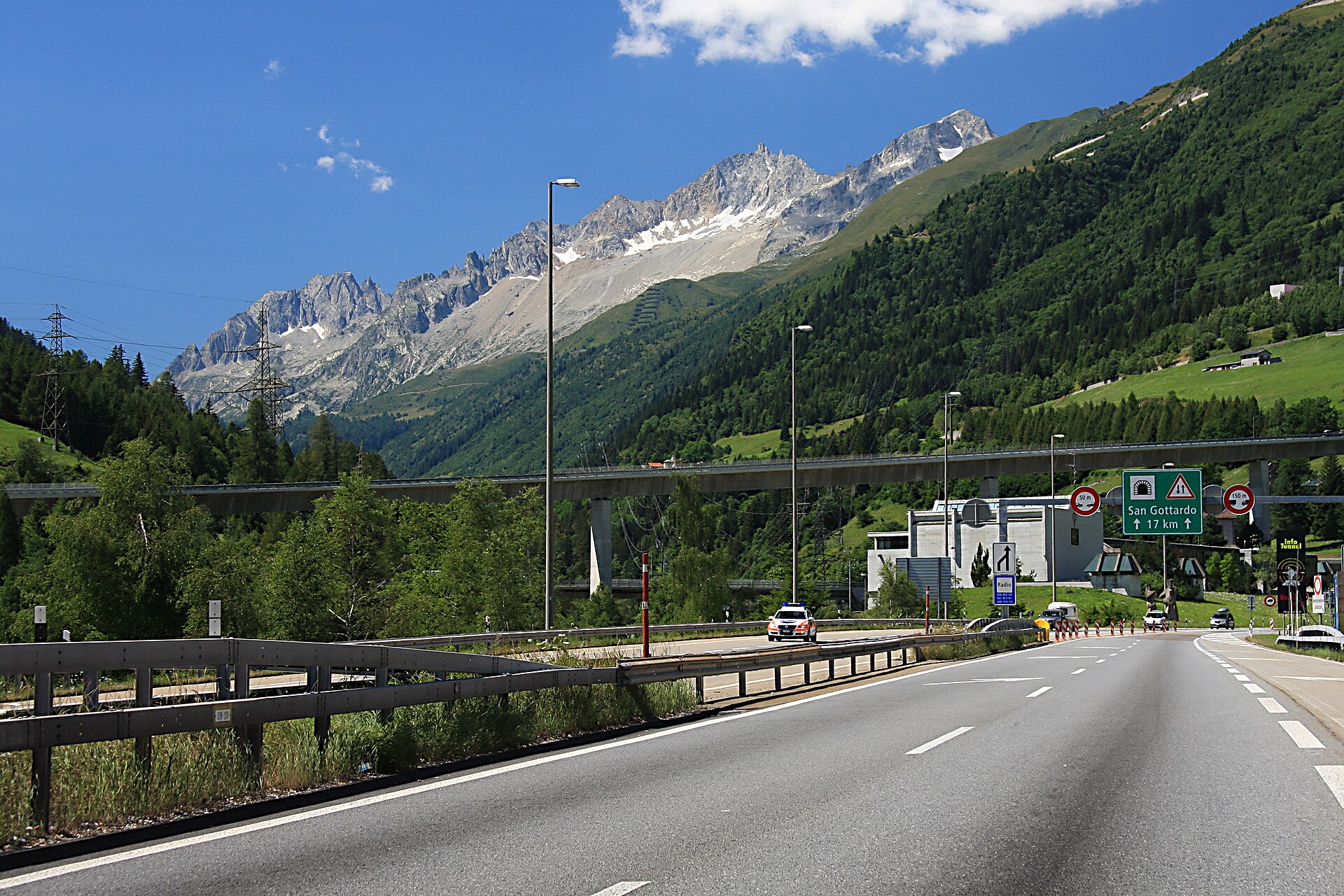
The road in the photograph below is an approach to the Gotthard tunnel area, where lane changes, tunnel signs and mountain weather meet. Keep a generous following distance, use headlights in the tunnel, and never stop on a carriageway or in a lay-by that is not signed for parking. For a scenic pass, schedule a fuel stop and a proper rest area before the climb rather than counting on a viewpoint to provide space.
.jpg)
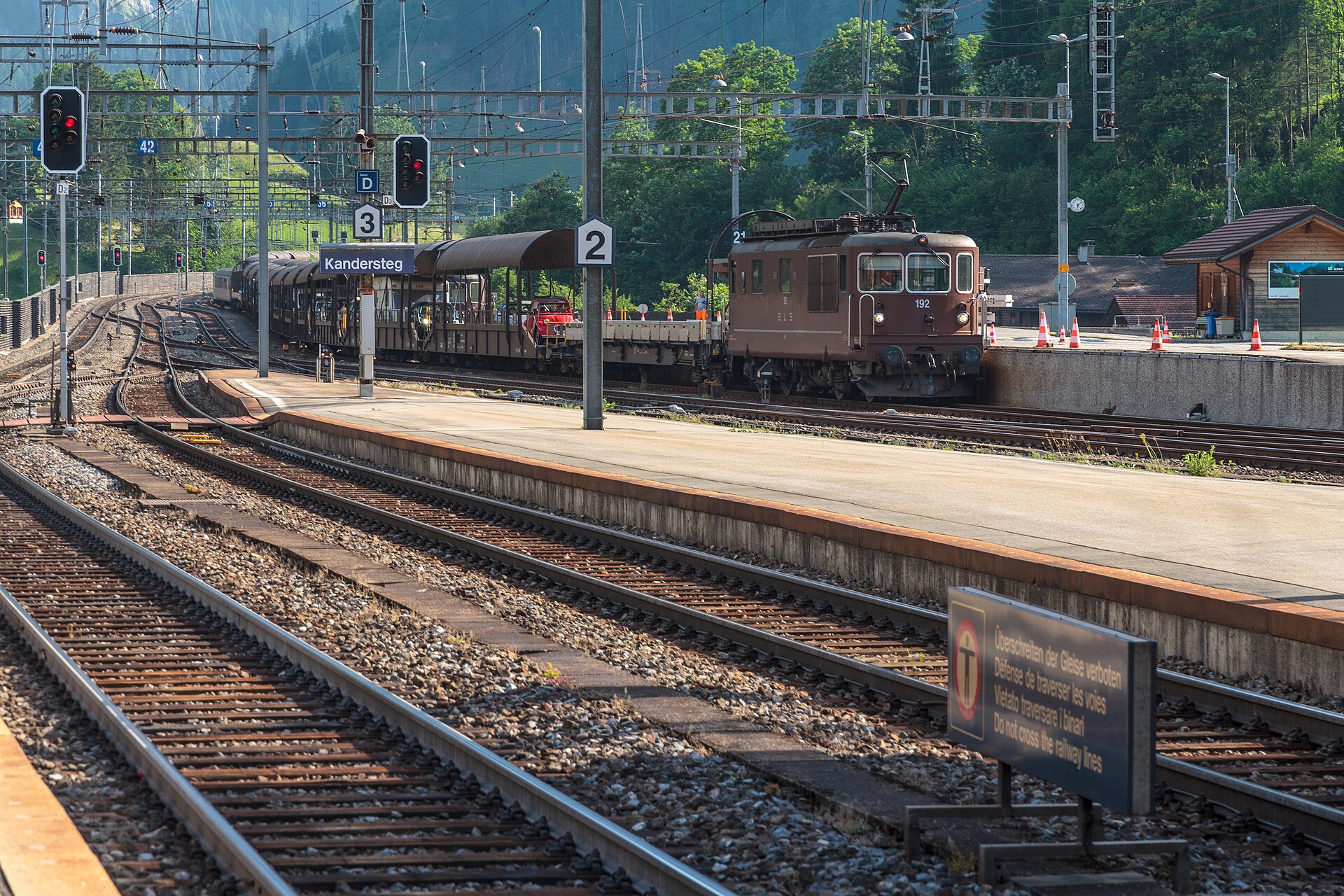
When a pass is closed or the weather no longer fits the vehicle, a car train can be the sensible route. BLS runs the Lötschberg car-transport service between Kandersteg and Goppenstein; the Furka service links Realp and Oberwald. Check vehicle height, ticket rules, departure times and queue conditions. The service is a transport option, not permission to drive onto a railway track: follow staff instructions and remain in the vehicle if the operator requires it.

Winter tyres, chains and weather
Switzerland has no nationwide rule that makes winter tyres compulsory on a fixed calendar date. ASTRA’s winter-service guidance says there is no legal winter-tyre obligation but recommends winter-suitable tyres, commonly described as October to Easter. If a vehicle is poorly equipped for the conditions and causes a collision, the driver can face consequences even without a date-based tyre law.
Ask the rental branch for the tyre type, tread condition and chain location. A blue snow-chain sign makes chains compulsory for the marked section; practise fitting them somewhere safe before the climb. Do not use a mountain pass as a test of a summer-tyred car. Check MeteoSwiss and the TCS pass page, and keep an alternative tunnel or lower valley route in the plan.
Parking and the rail alternative
Swiss parking bays are marked and the colour is only the start of the instruction. The national tourism board’s parking explanation describes blue zones, white paid spaces and yellow private or reserved spaces. In a blue zone, set the official parking disc to the next half-hour and display it; the sign beside the bay controls the hours and any local exception. A handwritten note is not a substitute for the disc.
In Zurich, Geneva, Lausanne and other dense centres, a car park or P+Rail site is usually less stressful than searching for a short-stay bay. Check the hotel’s access restriction, height limit and overnight rate before arrival. At a village viewpoint, use a marked bay and leave enough width for a postbus, emergency vehicle or snow-clearing machine.
Fuel, charging and a useful rental record
Main corridors have fuel stations and public chargers, but a pass road can have long gaps and seasonal opening hours. Ask whether the vehicle takes petrol 95, petrol 98 or diesel, and confirm the connector and payment method for an electric rental. Save the next staffed station before leaving a town; a map pin is not proof that the pump or charger is open.
Photograph the fuel or charge level, odometer, wheels, glass, bumpers and vignette at pickup and return. Keep the rental contract, roadside-assistance number and any cross-border authorisation together. These small records help when a toll, parking notice or damage question arrives after the trip.
Emergencies and breakdowns
Save these numbers before entering a long tunnel or a remote valley:
| Service | Number or action |
|---|---|
| European emergency number | 112 |
| Police | 117 |
| Fire service | 118 |
| Ambulance / medical emergency | 144 |
| Roadside assistance | 140 (chargeable; confirm the rental cover) |
| Traffic information | 163 (chargeable) or the TCS traffic map |
The Swiss travel-information page lists 117, 144 and 140 and links to live traffic sources. After a breakdown, switch on hazard lights, move behind a barrier only when it is safe, wear a reflective vest if supplied, and give the operator the road number, direction, kilometre marker and nearest sign. In a collision, call the appropriate service first, warn approaching traffic, exchange details and notify the rental company and insurer.
Official sources and review date
This page was reviewed on 17 August 2026. Licence and translation guidance comes from the Swiss foreign-licence information. Speed limits, child restraints and the motorway charge use ch.ch speed guidance, ch.ch child-seat guidance and the 2026 vignette page. Winter equipment uses ASTRA’s winter-service explanation. Pass conditions use the TCS passes portal; parking colours use Switzerland Tourism’s parking guidance; emergency numbers use Swiss travel information. Rules, road conditions, tariffs and rental terms can change, so reopen the named authority before departure.
Related guides and destinations
Frequently Asked Questions
- Can I drive in Switzerland with my foreign licence?
- Visitors may use a valid national licence for the vehicle categories it covers. If the licence cannot be read in German, French, Italian or English and you do not carry an IDP, bring an official translation with the original licence. Rental branches and insurers can apply additional document rules.
- Do I need an International Driving Permit in Switzerland?
- It is not a universal requirement for short visits. It is useful as a translation when the national licence is not in a Swiss official language or English, and it must be carried with the original licence. Confirm the rental branch's written requirement before payment.
- How much is the Swiss motorway vignette in 2026?
- The 2026 vignette costs CHF 40 and is valid from 1 December 2025 through 31 January 2027. There is no daily, weekly or monthly option. It is required for cars up to 3.5 tonnes using Swiss motorways and expressways.
- Does a rental car already have a vignette?
- Do not assume either way. Swiss-registered rental cars often arrive with one, while a cross-border rental may follow a different policy. Ask the branch to show the sticker or confirm the e-vignette plate registration before joining a green-signed motorway.
- What are the normal Swiss speed limits?
- The general limits are 50 km/h in built-up areas, 80 km/h outside them, 100 km/h on expressways and 120 km/h on motorways. A lower posted, tunnel or work-zone limit overrides the general number.
- Are winter tyres compulsory in Switzerland?
- There is no nationwide calendar-based winter-tyre obligation. ASTRA recommends winter-suitable tyres for the cold season, and unsuitable equipment can create liability after a crash. Fit chains when a blue chain sign requires them and check the pass status before leaving.
- How do I know whether an Alpine pass is open?
- Check the TCS Swiss passes portal immediately before the stage. It reports live opening status, weather and restrictions for major passes; a pass can close after a forecast, snowfall, rockfall or maintenance notice.
- How does blue-zone parking work?
- Blue-marked spaces normally require the Swiss parking disc during the posted daytime period, with arrival rounded up to the next half hour. White spaces may be metered or time-limited, and yellow spaces are generally private or reserved. Read the sign beside the bay.
- Should I drive in Zurich or Geneva city centres?
- Usually leave the car at a hotel garage, P+Rail site or peripheral car park and use local transport. Narrow streets, trams, one-way systems and expensive short-stay parking make a city loop less useful than a valley-to-valley stage.
- Which numbers should I save for a Swiss road emergency?
- Call 112 for the European emergency number, 117 for police, 118 for fire and 144 for medical help. Roadside assistance is 140, and TCS or the rental company's assistance number may be the correct channel for a non-life-threatening breakdown.
Information Sources & Disclaimer
This guide compiles information from the official transport authorities, road operators, government travel information, and automobile associations linked for Switzerland.
While we strive to keep this information as accurate and up-to-date as possible (last reviewed: August 2026), traffic laws and toll rates can change without notice. We recommend verifying critical information with the local authorities or your car rental agency upon arrival.
Learn more about our Editorial Process →Compare Your Origin and Destination
Use the comparison tool to check driving side, units, documents, and other destination data for your route.